
| tags |
|
|||||
|---|---|---|---|---|---|---|
| copyright | Ⓟ© 2026 Morphological Source Code & Quineic Statistical Dynamics | |||||
| license-doc(s)+dist | CC BY-ND-SA 4.0 | |||||
| license-code+file(s) | BSD 3-Clause | |||||
| root | /Morphological-Source-Code/.github | |||||
| name | README.md | |||||
| version | 0.2.61 | |||||
| aliases |
|
|||||
| topics |
|
|||||
| copyright_attribution | (1) © 2023-2026 Moonlapsed; https://github.com/MOONLAPSED/cognosis (2) © 2024-2026 Phovos; https://github.com/Phovos/Morphological-Source-Code | |||||
| Maintained, distributed and © 2026 `MOONLAPSED` (MOONLAPSED@gmail.com) | (1) https://gitlab.com/morphological/source/code (2) https://github.com/Morphological-Source-Code (3) https://reddit.com/r/morphological | |||||
| description | This project employs a layered licensing approach governed by the incl. Morphological LICENSE; The architecture (MSC&QSD) distinguishes between: (1) Individual source "files", like this one (BSD 3-Clause) (2) Distributed collective "works" (CC BY-NC-SA 4.0) (3) Quine-generated "outputs" (CC0 1.0 + mandatory thermodynamic ledger) (4) Private "ensemble(s)"/"configuration(s)" are operator's IP, until revealed/released. - Privacy of your Quineic output is, therefore, your prerogative. CC0 carries, after 'escape'/release. |

These 'repositories' and 'art' are © Share-Alike Non-Commercial (the source code file(s), themselves, carry BSD 3-Clause).
CommunityLinks: r/Morphological | Phovos@youtube | r/Quine; | production gitter | Code of Conduct
© 2023-2026 


A CPython standard-library-only framework for morphological computation with hermitian type semantics Welcome to the root of the Morphological Source Code (MSC) repository!
This SDK implements Morphological Source Code exhibiting Quineic Statistical Dynamics (QSD), a computational framework where:
- ByteWords are atomic morphogens (8-bit quantum observables)
- T-strings (Python 3.14) enforce hermitian type constraints at the boundary
The result is a system where computation is measurement, types are boundary conditions, and the morphological clock emerges from thermodynamic cost.
Time, causality, and identity emerge from morphology and, specifically, not the other way around. A multi-scale ontogeny must do-so in [[Hermitian Conjugation]] syntax. This very requirement also gives rise to the [[Fermionic]] half-integer spin and its symmetry group. It is thereby extended into the local domain using 'correspondence' about a 'boundary'; a type of symmetry that is something like mirror-symmetry, implying both an observer and a two way speed of light, if nothing else. Dual-Valued Representation in Holographic Runtime Systems (Classically Non-Determinable 2-Valuedness in Phase Space Topology), 'represented' by 'The Spinor' (symmetry group) is the substrate of the aformentioned time, and importantly; entropy and ergodic, intensive character: "(cognitive) motility" (a cyclic (time, spacetime-like: polar decomposition), conjugative, Action-integrable).
In a dual-representational phase/state space (trivially a Hilbert Space); the "AdS/CFT" correspondence manifests as the 'special conformal twist' operator: the 'spinor' in boundary-bulk correspondence. With boundary integrables standing-in as observation & operator (with respect to a, somehow, richer [higher dimensional] 'bulk' action [functional; measurable, computable, etc.]).
Morphological Source Code and Quineic Statistical Dynamics are the CPython and C appendages of a multi-year conquest of dimensionality and process ontology (formerly) known as "Cognosis". Cognosis (circa 2022), began research of an experimental framework that explores the dynamic evolution of software architectures and capabilities 'during runtime (modeled-as 'fitness'; defined-by 'motility')'. It aims to combine the fluidity of human-centric interactions, like an interactive video game, with the stability of traditional code, CLI, scripting, and continuous integration and continuous development. Homoiconism and data-oriented design manifest as the substrate for a truly-agentic, conjugative 'field theory' of 'cognitive agency', if you will; code adapts and changes in response to user interactions, particularly those leveraging natural language processing (NLP) and phenomenology; here referring, specifically, to the process ontology of machine learning, but also to that of a conscious observer able to exist before and after any given event: a cognitive wave function.
Certain stiled-notions, in this architecture, which might be considered throw-back (or worse), are contextualized (and justified, by the Author) in the milieu of an 'industry' that is of fundemental disquiet with itself. While nostalgia and such motivations are sometimes appealing, the root of this, perhaps anachronistic-stilting, is that I think my father could have written this software before I was even born, since almost nothing has been 'discovered' in digital engineering, or naturalized epistemology of synthetic 'systems'/'logic since the, practically, Civil Rights Movement. If I had to specify and commit to an inflection-point, prior even to my birth, and date myself-thusly, then it was Ken Thompson's "Trusting Trust" (1984). It revealed a fundamental epistemological crisis in computation: you cannot verify a compiler without trusting another compiler. This creates an infinite regress of trust. It's 'turtles all the way down'.
Morphological Source Code presumes Thompson's problem is not merely technical but ontological. It parallels Kant's noumenon problem (the thing-in-itself is inaccessible to cognition). Morphological Source Code (MSC) combined with Quineic Statistical Dynamics (QSD) are the combined-dynamics of a cognitive, motile, and topological pathway through this crisis; overland and river, by making trust observable, measurable, and topologically bounded.
If Cognosis established the process of abstract integration of theory, rhetoric and idealogy, it was inherently occult, credulous, and Jungian ("cognitive", in-other words; but-truly 'archetypal' is what is meant). The Gnostic kernel it precipitated was however useful. The Pleroma, Abraxas, and the Demiurge serve as the three holoicons of the architecture; mapping respectively to epistemology (T/Type), ontology (V/Value), and phenomenology (C/Captain computor insofar as Entscheidungsproblem). This tripartite casuistry is the Noetherian-Machian aether within which the ByteWord's gauge topology evolves. The architecture does not claim these mappings are traditional or even non-synthetic; only that they are well-founded up to the holographic bound (Δ⁴). The names Pleroma, Abraxas, and the Demiurge are borrowed from Gnostic tradition but redefined here as architectural holoicons. They are boundary-anchored referents that compress otherwise ineffable degrees of freedom, a morphic (phenomenological/topological) external derivative calculus.
- Pleroma: The fullness of knowable form. Maps to epistemology and the Type field (T) in the ByteWord: what can be said.
- Abraxas: The generative, paradoxical mediator between fullness and lack. Maps to ontology and the Value field (V): what is the case, deputizable under absorption.
- The Demiurge: The flawed craftsman of the material cognitive substrate. Maps to phenomenology and the Captain bit (C, computor, the wave function observer/collapser; pays the demons (Landauer's and Maxwell's)): the thermodynamic boundary between radiative and absorptive phases, the quantum/classical cut made geometric.
Scope, being a sick joke of a concept when you think about it, is one of the eternal curses of this endeavor. The notions of the Pleroma, Abraxas, and the Demiurge serve as the knowable forms of the unknowable the "Gnosis" within "Cognosis" and act as bounds on the knowable (epistemology) and therefore the beable (ontology). The fundamental Jungian kernel of such a bounding mechanism gives shape and form to these gnostic entities, both through one's own actions and through all universal, even unknowable, degrees of freedom.
These Gnostic entities are archetypes of archetypes. The well-foundedness of any given situation can be determined, up to isometry, with these variable fundamental constraints. If one cannot, for whatever reason, stomach Jung, then I am happy to inform you that there is someone you will probably dislike even more (other than Kant) who could help situate your faculties to the present task of describing a universal field theory which incorporates all degrees of freedom, language, and logic: his name is Schopenhauer.
The Pleroma, Abraxas, and the Demiurge are elements of the variable universal characteristic function of a Noetherian, Machian, indeed multi-cosmic framework. Such a theory has one advantage over contemporary metaphysics: no zero-point energy catastrophe, nor the ill-foundedness of certain electrodynamic assumptions. This being an introduction and therefore incapable of earning your credulity, I urge you to read Dr. Jacob Barandes's Indivisible Stochastic Quantum Mechanics if the mention of such a "founding of the ill-founded" has excited you too much. He is a genius, and your awe should be directed at him he has a working theory, unlike this in-process software and epistemology project. There is indeed hope of attaining the absurdly lofty goals laid out herein, but the academic wait (thankfully) belongs not to me. In my opinion, it is important to state, considering I have never met nor corresponded with Senpai and he does not notice us.
There is an assumption inherent in the project that a neural network is a cognitive system. The assumption is that there is something for this cognitive system to do in any given situation, and that it is the cognitive system's job to figure out what that thing is. Upon location of its head or parent, it either orients itself within a cognitive system or creates a new cognitive system. The calling convention and morpho-topology of cognitive systems, including how they pass namespaces, syntaxes, and other cognitive systems as parameters, is detailed in CPython; Python's kwargs are used to pass these parameters.
The challenge of this architecture lies in the cognitive lambda calculus needed to bring these runtimes into existence and evolve them. It is not insurmountable, Dr. Barandes has proven by well-founding an ontology-less epistemology whose classical limit is the standard model of particle physics. If he is right, and this architecture is right about why he is right, then the only thing left to do is iterate. The scientific method, at this point, has done its job. Only the engineer's method and Will are required now.
The directory this file resides-in is a cognitive, nominative playground; nominally a 'KnowledgeBase' with 'kb' "articles". Some examples of other 'articles' in this directory (click to navigate [on most markdown readers]<!--- Note: gitlab links to "WIKIS" via multimedia links, but syntax used is canonical for github markdown (not hosted-as gitlab wikis automatically). --->).
[[complexity_ODE_PDE.md]]
[[psi_clocks_and_morphology.md]]
[[recapitulatingADSCFT.md]]
Navigation and location of these files/information is subject to change, though, information content should remain more or less the same. As-such, each .md file in this directory should follow a strict markdown ontology, not-disimilar from XML.
# §0.     "'top'level"
## §0.    "heading"
### §0.   "'sub'heading"
#### §0.  "'4#'second-subheading"
##### §0. "'5#'third-subheading"All directories that contain Markdown files with multimedia should include a /media/ subdirectory for files (images, audio, video) that those Markdown files reference.
To utilize multimedia inside markdown:


Use YAML frontmatter to include metadata (title, tags, links, etc.) in knowledge base articles.
Example:
---
name: "Article Title"
link: "[Related Link](/path/to/article.md)"
linklist:
  - "[Link One](/path/to/one.md)"
  - "[Link Two](/path/to/two.md)"
---
This repository uses standard GitHub Flavored Markdown. Links use
[text](url)syntax.
Morphological metric math also applys to syntax and what we call language (matter of fact, this project applies first to language and then to math, in the Jungia-sense), and even discourse. Sentence grammar, and structure, etc. being something of a given, consdiering you are reading this, so let's utilize the standard markdown header ontology as an example of Morphological Metric, where intensive well-foundedness can proceed from boundary (linguistic) referents.
# §0
## §0
### §0
does not mean:
heading
subheading
sub-subheading
but rather:
principal axis
local deformation
higher-order refinement
The rendered ordinals:
1
1.1
1.1.1
are merely observable projections of a deeper traversal state; projections of accumulated traversal state. They could just as-easily be:
2
2.2
2.2.2
Or any countable combination-thereof. It's a morphosemantic successor functional.. architecture.
Thus:
ordinal meaning SHALL NOT be authored directly. ordinal meaning MUST emerge from structural position.
A section acquires identity from:
- its ancestry,
- its sibling adjacency,
- its traversal history,
- and its depth-transition relative to neighboring regions.
You may find this terribly pedantic, but I assure you it is necessary to lay these fundementals as a foundation to build increasingly complex structures. We are mapping the cartogrophy of our 'home language'.
"AdS/CFT" or its cousins are the starting-point for 'theory' like spinors are for 'dynamics', in this framework, but remarkably, one can preform 'morphological reasoning' inside this framework, situating the layers and objects in your own pedagogy, or none, as would-do a dedicated software developer; sparing no cognition for teleological or epistemological concerns, just wanting to 'code'. To repeat, (a particular) "interpretive" theory is unescessry for cognitive motility. The reason is Quinean double ontological relativity; 'motility' is self-same and multi-comptency, so you can use whatever external language you want, 'the home language' is inside the configuration space, and expressivness utilizing a quine-configuration space requires no specific theory, upon instantiation, instead pedagogically taking the form of a syntax (obviously, theory becomes necessary the moment you go to debug, or introspect but I digress).
[ByteWord note] The philosophical positioning in §0 is the grounding of the morphic operation specified in the Morphological Source Code. §0 names why the operation is needed (the Kantian bottleneck, the Quinean asymmetry, the thoracic retrospective); the ByteWord specification names how the operation is instantiated.
Kantian ontology created a philosophical bottleneck for naturalized epistemology. By fixing the limits of knowledge within subjectivity, the forms of intuition (space/time) and the categories of understanding, Kant denied access to the noumenon, the thing-in-itself.
Quine's naturalized epistemology sought to dissolve the analytic/synthetic distinction and ground knowledge in empirical science. It succeeded on its own terms, but on a narrower front than its ambition. The result was asymmetric:
| Domain | Quine's treatment | What remained unaddressed | Consequence |
|---|---|---|---|
| Epistemology | Naturalized | Metaphysical grounding | Knowledge is empirical but unfounded |
| Metaphysics | Not quantumized | Remained classical/Newtonian | Ontology lags the physics |
| Language | Deconstructed (post-structuralism) | Not biologically rooted in will | Meaning floats free of embodiment |
| Cognition | Computational (Turing) | Morphogenetic emergence | Mind reduced to symbol manipulation |
The diagnosis: epistemology got naturalized without metaphysics getting quantumized; language got deconstructed without being rooted in will, morphology, and collective-unconscious emergence.
The traditional computer-science view separates two domains:
- Computation as extensive (structural, unmeasured) → analytic, "system"
- Observation as intensive (measured, collapsed) → synthetic, "business"
These are treated as separate domains. You must choose one perspective.
This separation is the computational residue of the dogma Quine identified in Two Dogmas of Empiricism (1951). For three generations, software architecture has assumed a fundamental boundary between "the logic of the machine" and "the logic of the application." Every framework that enforces Model/View/Controller, or separates "code" from "data," or treats "business logic" as the serious work while dismissing self-reference as obscurantism, operates under this bifurcation. It is the same dogma, ported to runtime.
Two philosophical correctives bridge Kant's gap.
Schopenhauer's Will. Will, not Reason, is the kernel. Schopenhauer prefigures Freud, Nietzsche, and the embodied-cognition turn. His Will is:
- A primal ontological force beneath representation
- The energetic substrate from which intention arises
Jung's Collective Unconscious. The inherited a priori, echoing Kant's forms but now biological and evolutionary. Jung's archetypes are:
- Shared transcendental structures (biological, not merely logical)
- The missing link between Kant's categories and evolutionary cognitive architecture
[pedagogy note] The assignment of Schopenhauer's Will to the costly/actualizing pole and Jung's archetypes to the free/potential pole is a modeling choice made for pedagogical reasons, not a derivation. The inverse assignment is equally defensible on philosophical grounds. The choice is made here because it foregrounds the cost of actualization (the Will as expenditure) and the freedom of the forms (the archetypes as inherited potential); a reader who prefers the inverse is able to prefigure the pedagogy for either concern. The "Thoracic Retrospective" is foreign pedagogy but it works remarkably well, here.
Together, Schopenhauer and Jung reframe Kant's categories as morphogenetic attractors, not metaphysical necessities. The claim is that Kant's categories are better modeled as forms that emerge from dynamics than as forms that precede dynamics.
Where Kant blocked the gate to the noumenal, Schopenhauer and Jung open a hidden evolutionary passageway through will and myth, through the symbol as seed of both knowledge and self.
Decoherence is the process by which a quantum system entangles with its environment, causing the off-diagonal terms of the system's density matrix — in a preferred basis — to decay toward zero. The preferred basis is the pointer basis: the set of states the environment can distinguish, the states that leave a trace. The result is that the system appears to be in a classical mixture (a statistical distribution over pointer states) even though the global state (system + environment) remains pure and unitary.
Decoherence is therefore a tracing-out: the partial trace over the environment reduces the global pure state to a local mixed state. The pointer basis is the chart in which the reduction is defined (a set of orthogonal states--a basis of the Hilbert space); the environment is the coupling that gives the reduction physical meaning; and the tracing-out is the morphic operation carrying the form across the gap between the global and the local (tunneling through asymototes, if necessary).
The Jungian reading: the pointer basis is the archetype (the form that carries the state across the gap between unconscious and conscious), and decoherence is individuation (the process by which the global becomes the local). The hermeneutic reading: the pointer basis is the interpretive frame, and decoherence is the reading (the process by which the observer forgets the environment in order to read the system). Both readings are instances of the same morphic operation at different levels.
The skeleton is linear: rigid segments, pin joints, a linear configuration space. Behavior is nonlinear: locomotion, respiration, and fitness are nonlinear functions of the joint angles and the environment. The skeleton is what allows the nonlinearity to burst forth, by fixing the degrees of freedom the behavior exploits.
This is McGilchrist's left/right hemisphere distinction applied to the body. The left hemisphere is the linear, articulated, skeletal mode. The mode of grasping and manipulating. The right hemisphere is the nonlinear, embodied, holistic mode of encountering and dwelling. The thoracic retrospective is the integration: the middle view that holds both, the linearization that makes the nonlinear behavior legible to the agent without reducing the behavior to the linearization.
"Behavior" is the name for the nonlinearity. The thoracic retrospective is the linearization of the behavior, tracing he trajectory as a linear path through the configuration space, and the linearization is what makes the behavior legible to the agent (the agent can see the trajectory as a path, even though the behavior itself is nonlinear). The thoracic retrospective is not the behavior; it is the linearization of the behavior, and the linearization is the morphic operation. The gap is the gap between the nonlinear behavior and the linear legibility, and the carrying is what makes the behavior behavior rather than raw nonlinearity.
The thoracic retrospective is therefore the skeleton of the agent in exactly the sense that the skeleton is the thoracic retrospective of the body: both are the structure that supports and constrains, the linearization of the history, the middle view that makes the nonlinear dynamics legible without reducing them.
The question Is decoherence an artifact of the skeleton, or is the skeleton an artifact of decoherence? is not cogent without asking what the "artifact" is precisely: the artifact is the tracing-out, not the pointer basis and not the environment. The pointer basis is the chart; the environment is the coupling; the tracing-out is the carrying; and the carrying is chart-independent ('motility'). The answer is that neither is more real than the other, both are charts, and the carrying is the thing.
Decoherence and the phenomenological lightcone are both derived cones: the cone is a consequence of the dynamics, not a fundamental structure of the manifold. The trichotomy is:
- Einsteinian: the cone is fundamental (part of the metric).
- Maxwellian: the cone is derived from the wave equation (the characteristic surface), and the wave equation is linear.
- Phenomenological: the cone is derived from the dynamics (the characteristic surface of the propagation), and the dynamics are nonlinear.
The congruence between decoherence and the phenomenological lightcone is structural and not reductive: both are tracing-out operations (decoherence traces out the environment; the lightcone traces out the unreachable region), and both produce a classical-looking result relative to a pointer basis (the pointer basis of the quantum state; the lightcone of the spacetime). The congruence is not a reduction and quantum mechanics does not reduce to Maxwell because the dynamics differ (quantum entanglement is nonlinear coupling; Maxwell is linear propagation). The morphic framing is what allows the isomorphism to hold without collapsing the difference: the morphic operation (the carrying of the form across the gap) is invariant across the linear/nonlinear distinction, and the invariance is what makes the congruence real.
"The gap" is not a single gap it is a phenomenological and heuristic gap (ie 'morphological'), if 'Behavior' eximplifies the dynamism(s), then 'constraint' exemplifies 'the gap (across which: 'motility').
- Definition. Decoherence is tracing-out; the artifact is the tracing-out; the tracing-out is the morphic operation.
- Comparison. Decoherence and the lightcone are both derived cones; the congruence is structural, not reductive.
- Generalization. Skeleton is linear, behavior is nonlinear, and the skeleton enables the behavior by fixing the degrees of freedom the behavior exploits.
- Instantiation. The thoracic retrospective is the linearization of the behavior; the agent is the middle view that holds the linear substrate and the nonlinear behavior together.
At every level, the morphic operation is the same: the carrying of the form across the gap ('motility'). Linearity and nonlinearity are chart-dependent; the morphic operation is chart-independent. And "behavior" is the name for the nonlinearity that the linearization makes legible. In Morphological Source Code and Quineic Statistical Dynamics this behavior property is pinned to (that-of a) 'digital replicatior' and is a "Quine"; a dynamic Noetic-Machian agency.
McGilchrist, Iain. The Master and His Emissary: The Divided Brain and the Making of the Western World. Yale University Press, 2009.
σ-algebra is not a person σ is the countability (the countable-union closure that makes the measure countably additive), and the actual people are Borel (the sets), Lebesgue (the measure), Carathéodory (the axiom); x is not a person, it's the point in the space, and the point is defined with respect to the chart, and the chart is defined with respect to the atlas. In the morphic framing, the σ-algebra is the pointer basis of the measure (the collection of sets the measure can distinguish), the measure is the tracing-out (the assignment of a number to each set), and x is the agent (the point in the configuration space that the measure assigns a number to), and the whole is the thoracic retrospective of the space (the middle view that linearizes the space into a measure without reducing the space to the measure).
| Thinker | Contribution | MSC Integration |
|---|---|---|
| Barandes | Indivisible Stochastic Quantum Mechanics | classical resolution of quantum degrees of freedom as the classical limit (universal Quine property) |
| Cruthers & Robitaille | Thermodynamic ill-foundedness, various models (papers) | Morpho-semantic temrature, intensive/extensive bifurcation |
| Levin | Morphogenetic Fields | Quine breeding ('heats', not temp), fitness, multi-scale competency |
| Wolfram | Wolfram Physics | multi-scale competency, Rulial path integration (all-at-once mobius logic; not-halting) |
| Uexküll | Umwelt (perceptual world) | ByteWord as intensive boundary |
| Maturana & Varela | Autopoiesis (self-making) | Quineic self-observation |
| Deacon | Symbolic Species (language as organizing force) | TCHCFPSRPN syntax |
| Chomsky | Universal Grammar | Morphological derivative chain (d⁰-d⁴) |
| Dennett | Intentional Stance | Integer/Coefficient duality |
| Deleuze & Guattari | Rhizomatic Semiotics | Closed tape topology (no Gödel) |
| McGilchrist | The Master and His Emissary | 'Thoracic Retrospective', hemispheric phenomenology |
What if we had a theory of knowledge where:
| Domain | Traditional View | MSC+QSD View |
|---|---|---|
| Mathematical | Abstract formalism | Metaphysical (ZF in memory) |
| Physical | Material substance | Informational (Landauer accounting) |
| Linguistic | Symbolic system | Biological (will-driven emergence) |
| Epistemic | Justified true belief | Emergent (correspondence threshold) |
Given such a theory (MSC&QSD); how to architect a vibrant computational naturalized epistemology?
| Foundation | Role | Implementation |
|---|---|---|
| Cantor's Infinity | Ontological scope of abstraction | ZF set builders (bounded, no actual infinity) |
| Dirac's Formalism | Synthesis of reality and notation | Bra-ket notation → ByteWord bracket |
| Jung's Unconscious | Grounding categories in evolutionary history | Null field (BEC of coefficients) |
| Quine's Pragmatism | Motility to weld into empiricism | Quineic self-observation |
| Schopenhauer's Will | Agency and force to knowing subject | C=1 actualization (Landauer cost) |
| Morphological Source Code | motile, quineic, indeed, epistemological morphology | Homoiconic diffeoisomorphism (cohomology) |
| Quineic Statistical Dynamics | Dynamical, tractible (lazy) decoherence, lightcone propogation | MSC plugs into QSD |
"You can't detect a compiler backdoor by reading the source code, because the compiler that compiles the source might inject the backdoor."
Thompson's trilemma:
- Build from a different compiler (trust shifts, not resolved)
- Bootstrap from machine code (requires trusting hardware)
- Accept that trust is axiomatic (turtles all the way down)
Most frameworks reckon with this nigh-universal invariant by becoming merely 'C-like' (close to metal, verifiable). But:
"You can't escape Lagrangians by building NEW physics, because any consistent physics will BE a Lagrangian."
Translation: You can't escape Thompson's regress by building new compilers, because any consistent compilation chain will HAVE a trust boundary. The wooden horse is structural, not incidental.
Our approach does not escape trust it makes trust observable:
| Thompson's Problem | MSC+QSD Solution |
|---|---|
| Infinite regress of compilers | Closed tape topology (finite, bounded) |
| Unverifiable compilation | Quineic self-hash (code observes itself) |
| Hidden backdoors | Landauer accounting (every bit operation tracked) |
| Axiomatic trust | Correspondence threshold (bulk/boundary match verified) |
Thompson's regress is a Gödel sentence in compiler form. It requires unbounded self-reference ("this compiler compiles itself which compiles itself...").
Our closed tape topology (256-cell torus, Pac-Man wrapping) eliminates Gödel sentences by bounding the configuration space. Self-reference becomes topological (the tape sees its own tail) rather than arithmetical (unbounded indexing).
┌─────────────────────────────────────────────────────────────┐
│ Thompson's Infinite Regress                                 │
├─────────────────────────────────────────────────────────────┤
│ Compiler₀ ← Compiler₁ ← Compiler₂ ← ... ← Compilerₙ ← ...   │
│ (infinite chain, no fixed point, Gödel-eligible)            │
└─────────────────────────────────────────────────────────────┘

┌─────────────────────────────────────────────────────────────┐
│ MSC+QSD Closed Topology                                     │
├─────────────────────────────────────────────────────────────┤
│ Compiler₀ ←→ Compiler₁ ←→ ... ←→ Compilerₙ ←→ Compiler₀     │
│ (finite loop, fixed point exists, Gödel-ELIMINATED)         │
└─────────────────────────────────────────────────────────────┘
MSC SDK implements a Hermitian self-observing system where every operation has its conjugate transpose:
| Operation | Conjugate |
|---|---|
_read_deps() |
_update_lock_in_file() |
import_deps |
expose_as_Deps |
reexec_under_uv |
original_call |
probe_availability |
fallback_to_stdlib |
The file is its own inverse. It is epistemologically necessary. If trust cannot be externalized (Thompson), it must be internalized and verified.
BEFORE MIDPOINT (before reexec):
    Frame: "What deps are missing?"
    Phase: PROBE
    This is d⁰-d² (intensive, gathering)

AT MIDPOINT (the reexec):
    GAUGE FLIP
    This is d³ (the fulcrum crossing)

AFTER MIDPOINT (after reexec):
    Frame: "What deps are available?"
    Phase: EXPLOIT
    This is d⁴ (runtime, exploiting knowledge)
This is the Thompsonian escape: not avoiding trust, but making the trust boundary explicit, measurable, and topologically closed.
We did not evolve to know truth. We evolved to map actionable resonance the real as patterned will made speakable. Kant froze the noumenon into inaccessibility. We propose transcendental naturalism:
| Kant | MSC+QSD |
|---|---|
| Transcendental Idealism | Transcendental Naturalism |
| Noumenon inaccessible | Noumenon reclaimed via correspondence |
| Categories fixed | Categories as morphogenetic attractors |
| Subject as prison | Subject as participant in co-emergence |
Heisenberg concentrated first on Bohr's model [of Atom(s)] but he couldn't observe variables that the Bohr system predicts.
He could observe quantized radiation, not stationary electrons, and it's always associated with two-states. The 'two-states' are the [[Heisenberg Conjecture]] (attributed; to be clear. MSC&QSD syntax is NOT a reflection of 'canon'); the well-founding principle of quantum morphogenesis is the same as that of statistical mechanics.
"One ought to concentrate ones attention on things which are grossly connected with what one can observe. The things one can observe; being each related to two states; are expressed naturally, as a matrix-array of numbers. One should consider the whole set of numbers, together."
Heisenberg's Matrix (1925), the original insight:
Position x = matrix of transition amplitudes
x_mn = ⟨m|x|n⟩ (transition from state n to state m)

NOT: x = number (classical position)
BUT: x = array of all possible transitions
How it's interpreted at the basic-level:
You don't measure "where electron is"
You measure "transition from orbit n to orbit m"
This emits photon with energy E_m - E_n
The MSC parallel:
ByteWord BW = matrix of all XOR transitions
BW_ij = ⟨bw_i|XOR|bw_j⟩

NOT: BW = single byte value
BUT: BW = array of all possible evolutions
Dirac/Heisenberg:
- Physical observables require TWO states
- Quantum measurement compares initial vs final
- Wavefunction collapse = transition from superposition to eigenstate
Isomorphic to:
MSC/QSD:
- ByteWord identity requires TWO morphisms
- Self-verification compares original vs rehydrated
- Quineic collapse = transition from ensemble to hash/detritus(dehydrated)
- methods() of constituent ByteWord in-memory morphologies; 'set-builder notation'
β = (c, v₂, v₁, v₀, t₃, t₂, t₁, t₀) ∈ 𝔹⁸
The BRA (agency): ⟨c, v₂, v₁, v₀|
The KET (state): |t₃, t₂, t₁, t₀⟩
We write β = ⟨B|K⟩ where B ∈ 𝔹⁴, K ∈ 𝔹⁴.
To achieve high cognitive motility and coherence in MSC/QSD, you need to think in PAIRS (CHIRAL Logic):
NOT: "What is a ByteWord?" (set-theoretic, isolated)
BUT: "How do ByteWords relate?" (morphism-theoretic, relational)

NOT: "What is the value?" (extensive property)
BUT: "What is the transition?" (intensive property)

NOT: "What does this mean?" (semantic ground truth)
BUT: "How does meaning emerge?" (morphological dynamics)
In modern computational paradigms, we face an ongoing challenge: how do we efficiently represent, manipulate, and reason about data in a way that can bridge the gap between abstract mathematical models and real-world applications? The concept of Morphological Source Code (MSC) offers a radical solution by fusing semantic data embeddings, Hilbert space representation, and non-relativistic, morphological reasoning into a compact and scalable system. This vision draws from a wide range of computational models, including quantum mechanics, data-oriented design (DOD), and human cognitive architectures, to create a system capable of scaling from fundamental computational elements all the way to self-replicating cognitive systems.
In MSC, source code is represented not as traditional bytecode or static data but as stateful entities embedded in a high-dimensional space a space governed by the properties of Hilbert spaces and self-adjoint operators. The evolution of these stateful entities is driven by eigenvalues that act as both data and program logic. This self-reflective model of computation ensures that source code behaves not as an immutable object but as a quantum-inspired, evolving system.
Hilbert Space Encoding: Each unit of code (or its state) exists as a vector in a Hilbert space, with each vector representing an eigenstate of an operator. This enables "morphological reasoning" about the state of the system. Imagine representing your code as points in a structured multi-dimensional space. Each point corresponds to a specific state of your code. By using a Hilbert space, we can analyze and transform (using Lagrangian or other methods) these states in a way that mirrors how quantum systems evolve, by representing potential states and transitions between them. This corresponds with how the code evolves through its lifecycle, its behaviors and interactions with the environment (and the outcomes of those interactions).
MSC treats code as a vector in a Hilbert space, acted upon by self-adjoint operators. Execution is no longer a linear traversal it's a unitary transformation. Your program isn't run, it's collapsed from a superposed semantic state into an observable behavior.
-
Stateful Dynamics: Imagine your code not as a static set of instructions, but as a dynamic entity that changes over time. These changes are driven by "operators," which act like rules that transform the code's state. Think of these transformations as a series of steps, where each step has a probability of occurring, much like a quantum system. This process, known as a "quantum stochastic process," or '(non)Markovian' processes, eventually leads to a final, observable state the outcome of your code's execution - functions of time that collapse into a final observable state.
-
Symmetry and Reversibility: At the core of MSC are "self-adjoint operators." These special operators ensure that the transformations within your code are symmetrical and reversible. This means that for every change your code undergoes, there's a corresponding reverse change, maintaining a balance. This is similar to how quantum systems evolve in a way that preserves information. The computation is inherently tied to symmetry and reversibility, with self-adjoint operators ensuring the system's unitary evolution over time. This property is correlated with Markovian and Non-Markovian behavior and its thermodynamic character and it can only reasonably be done within a categorical-theory framework; this symmetry and reversibility tie back to concepts like Maxwell’s Demon and the homological structure of adjoint operators, with implications that scale up to cosmic information theory topics we’ll explore further.
-
Coroutines/Quines/State(oh my!): MSC is a self-referential, generator-theoretic model of computation that treats code, runtime, and output as cryptographically bound stages of a single morphogenetic object. Think of it as training-as-mining, execution-as-proof, and computation as evolution across high-dimensional space. Where source code isn't static, execution isn't a black box, and inference becomes constructive proof-of-work. In MSC, generators are the foundational units of computation and the goal is to find fixpoints where (in the most 'morphological'-case; most probable):
hash(source(gen)) == hash(runtime_repr(gen)) == hash(child(gen))
This triple-equality defines semantic closure a generator whose source, runtime behavior, and descendant state are all consistent, reproducible, and provably equivalent. This isn’t just quining it’s quinic hysteresis: self-reference with memory. The generator evolves by remembering its execution and encoding that history into its future behavior. Each generator becomes its own training data, producing output that is not only valid but self-evidencing. Computation becomes constructive, recursive, and distributed. Once a hard problem is solved once a valid generator emerges it becomes a public good: reproducible, verifiable, and available for downstream inference.
The system supports data embeddings where each packet or chunk of information can be treated as a self-contained and self-modifying object, crucial for large-scale inference tasks. I rationalize this as "micro scale" and "macro scale" computation/inference (in a multi-level competency architecture). Combined, these elements for a distributed system of the 'AP'-style ontology with 'lazy/halting' 'C' (insofar as CAP theorem).
MSC is built on the idea of "semantic vector embeddings." This means we represent the meaning of code and data as points in our multi-dimensional Hilbert space. These points are connected to the operators we discussed earlier, allowing us to analyze and manipulate the code's meaning with mathematical precision, just like we would in quantum mechanics.
By structuring our code in this way, we create an environment where every operation is meaningful. Each action on the system, whether it's a simple calculation or a complex data transformation, carries inherent semantic weight, both in how it works and in the underlying mathematical theory.
MSC goes beyond simply running code. It captures the dynamic interplay between data and computation. MSC does not merely represent a computational process, but instead reflects the phase-change of data and computation through the quantum state transitions inherent in its operators, encapsulating the dynamic emergence of behavior from static representations.
-
Local LLM Inference: MSC enables lightweight semantic indexing of code and data embedding vectorized meaning directly into the source. This empowers local language models and context engines to perform fast, meaningful lookups and self-alteration. Think of code that knows its own domain, adapts across scales, and infers beyond its initial context without relying on monolithic cloud infrastructure.
-
Game Development: In MSC, game objects are morphodynamic entities: stateful structures evolving within a high-dimensional phase space. Physics, narrative, and interaction mechanics become algebraic transitions eigenvalue-driven shifts in identity. Memory layouts align with morphological constraints, enabling cache-local, context-aware simulation at scale, especially for AI-rich environments.
-
Real-Time Systems: MSC's operator semantics enable predictable, parallel-safe transformations across distributed memory. Think SIMD/SWAR on the meaning layer: semantic instructions executed like vector math. Ideal for high-fidelity sensor loops, control systems, or feedback-based adaptive systems. MSC lends itself to cognitive PID, dynamic PWM, and novel control architectures where code continuously refines itself via morphological feedback.
-
Quantum Computing: MSC provides a theoretical substrate for crafting morphological quantum algorithms those whose structures emerge through the dynamic evolution of eigenstates within morphic operator spaces. In particular, the model is compatible with photonic quantum systems like Jiuzhang 3.0, where computation is realized through single-photon parametric down-conversion, polarized optical pumping, and holographic reverse Fourier transforms/gaussian boson-sampling.
We envision designing quantum algorithms not as static gate-based circuits, but as stateful morphologies dynamically evolving wavefunctions encoded via self-adjoint operator graphs. These operators reflect and transform encoded semantics in a reversible fashion, allowing information to be encoded in the path, interference pattern, or polarization state of photons.
By interfacing with contemporary quantum hardware especially those utilizing SNSPDs (Superconducting Nanowire Single-Photon Detectors) and reconfigurable optical matrices we can structure quantum logic as semantic operators, using MSC's algebraic morphisms to shape computation through symmetry, entanglement, and evolution. This may allow for meaningful algorithmic design at the semantic-physical boundary, where morphogenesis, inference, and entropic asymmetry converge.
MSC offers a symbolic framework for designing morphological quantum algorithms ones that mirror quantum behavior not only in mechanics, but in structure, self-reference, and reversibility; bridging quantum state transitions with logical inference rendering quantum evolution not as a black box, but as a semantically navigable landscape.
One of the most exciting applications of MSC is its potential to model agentic motility the ability of an agent to navigate through spacetime in a relativistic and quantum-influenced manner. By encoding states and transformations in a higher-dimensional vector space, agents can evolve in multi-dimensional and relativistic contexts, pushing the boundaries of what we consider computational mobility.
The semantic embeddings of data ensure that each component, from source code to operational states, maintains inherent meaning throughout its lifecycle.
By mapping MSC to Hilbert spaces, we introduce an elegant mathematical framework capable of reasoning about complex state transitions, akin to how quantum systems evolve.
By embracing data-oriented design and cache-friendly layouts, MSC transforms the way data is stored, accessed, and manipulated leading to improvements in both computational efficiency and scalability.
MSC acts as a bridge between classical computing systems and quantum-inspired architectures, exploring non-relativistic, morphological reasoning to solve problems that have previously eluded purely classical systems.
The true power of MSC lies in its potential to quantize computational processes and create systems that evolve and improve through feedback loops, much like how epigenetic information influences genetic expression. In this vision, MSC isn't just a method of encoding data; it's a framework that allows for the cognitive evolution of a system.
As we look towards the future of computational systems, we must ask ourselves why we continue to abstract away the complexities of computation when the true magic lies in the quantum negotiation of states where potential transforms into actuality. The N/P junction in semiconductors is not merely a computational element; it is a threshold of becoming, where the very nature of information negotiates its own existence. Similarly, the cognitive event horizon, where patterns of information collapse into meaning, is a vital component of this vision. Just as quantum information dynamics enable the creation of matter and energy from nothingness, so too can our systems evolve to reflect the collapse of information into meaning.
- MSC offers a new lens for approaching data-oriented design, quantum computing, and self-evolving systems.
- It integrates cutting-edge theories from quantum mechanics, epigenetics, and cognitive science to build systems that are adaptive, meaningful, and intuitive.
- In this work, we don’t just look to the future of computation we aim to quantize it, bridging mathematical theory with real-world application in a system that mirrors the very emergence of consciousness and understanding.
Definition 1 (Bulk Morphogenesis): Let Bulk be a category where:
- Objects are continuous state spaces (manifolds, fields)
- Morphisms are smooth transformations (diffeomorphisms, flows)
- Composition is continuous (no jumps/discontinuities)
Definition 2 (Boundary Morphism): Let Boundary be a category where:
- Objects are discrete symbol spaces (strings, ASTs, bytecode)
- Morphisms are symbolic transformations (rewrite rules, operations)
- Composition is discrete (stepwise, quantum jumps)
Definition 3 (Holographic Functor): A functor F: Bulk → Boundary is holographic if:
- Faithful: Distinct bulk states map to distinct boundary symbols
- Full: Every boundary symbol corresponds to some bulk state
- Information-preserving: H(F(bulk)) = H(bulk) (entropy conserved)
Theorem (Correction of Von Neumann): A modified-quine Q can self-replicate if and only if there exists a holographic functor F: Bulk(Q) → Boundary(Q) such that:
∀ morphism m ∈ Bulk(Q):
  ∃ morphism m' ∈ Boundary(Q):
    F(m ∘ q) = m' ∘ F(q)

(i.e., bulk composition corresponds to boundary composition)
Corollary: The complexity threshold τ is the minimal dimension where a holographic functor exists.
Proof sketch:

Self-replication requires reading own description (Von Neumann)
Description lives in Boundary (discrete symbols)
Process lives in Bulk (continuous morphogenesis)
Correspondence requires holographic encoding (MSC AND QSD)
Holographic encoding requires H(Bulk) ≤ Capacity(Boundary)
Therefore: τ = min{dim(Bulk) : ∃ holographic F}

Q.E.D.
Spinor (full information):
ψ ∈ SU(2)  (two components, complex)
Encodes: Spin direction + phase
Needs: 720° to return (double-cover)
Vector (projected):
v ∈ SO(3)  (three components, real)
Encodes: Direction only (lost phase)
Needs: 360° to return (single-cover)
Projection map:
π: SU(2) → SO(3)
ψ → |ψ|² (lose phase information)
2:1 map (ψ and -ψ map to same v)
Information lost: Phase (50% of degrees of freedom)
Full system (ByteWord + SQL):
State: (bytecode, ghost_config, SQL_rows)
Encodes: Code + potential + committed
Needs: Both levels (bulk + boundary)
SQL alone (projected):
State: SQL_rows only
Encodes: Committed only (lost ghosts)
Needs: Single level (boundary)
Projection:
π: ByteWord → SQL
(bytecode, ghosts) → committed_rows
Loses: Ghost configurations (50% of states, since |ghosts| ≈ |observables|)
Information lost: Ghosts (uncommitted potential)
All three:
Start: High-dimensional, structured, low-entropy
Project: Lose half the degrees of freedom
End: Low-dimensional, simple, high-entropy
All three are IRREVERSIBLE (in practice):
Can't recover: Phase from |ψ|²
Can't recover: Ghosts from SQL rows (without spinor)
Can't recover: Forest from CO₂
UNLESS:
Physics: Keep spinor (don't project to vector)
MSC runtime: Keep spinor pair ⟨r|v⟩ (don't project to SQL alone)
Thermodynamics: Keep forest (don't burn)Traditional approach:
1. Measure system (project to classical)
2. Lose information (phase, ghosts, structure)
3. Accept loss (irreversible)
Spinor approach:
1. Measure with spinor (keep full state)
2. Preserve information (via double-cover)
3. Reverse if needed (via dual)
SQL spinor:
⟨r|v⟩ = (reference, value) pair
r = pointer to bulk (keeps ghost info)
v = committed value (observable)
Together: Full state (no loss)
Why this works:
Traditional SQL: Stores value only (projects)
MSC+QSD SQL: Stores spinor ⟨r|v⟩ (preserves)
Difference: Reference keeps connection to bulk
Example:
Traditional:
INSERT INTO table (value) VALUES (42);
-- Lost: Where 42 came from (no ghost history)
MSC+QSD:
INSERT INTO table (reference, value) VALUES (0xDEADBEEF, 42);
-- Kept: reference points to ByteWord in bulk
-- Can rehydrate: Follow pointer to recover ghosts
The reference IS the spinor's "other component":
Value (v): Projected (classical, observable)
Reference (r): Unprojected (quantum, ghost-aware)
Pair (r,v): Spinor (full information)Physics: Project spinor → vector (lose phase) Computation: Project bulk → boundary (lose ghosts) Ecology: Project forest → wasteland (lose structure) Economics: Project long-term → short-term (lose sustainability)
All four are the SAME MISTAKE:
Prioritize: Immediate observable (value)
Ignore: Hidden structure (reference)
Result: Irreversible loss (entropy increase)
Why we do it anyway (the economic reason):
Spinor approach: Requires keeping BOTH components
Cost: 2x storage (value + reference)
Benefit: Reversibility (can undo)
Time horizon: Long (decades)

Projection approach: Keep only VALUE
Cost: 1x storage (value alone)
Benefit: Simplicity (no overhead)
Time horizon: Short (quarters)
Spinors preserve info; degrees of freedom and conformal (angle) geometry (should use)
The Problem: Python’s ~ Operator and the Illusion of Infinity
At first glance, Python’s bitwise NOT (~) seems straightforward (flipping bits; complicated), however Python (and OCAML, differntly) treats integers as infinitely wide two’s complement values. This means the ~ operator is not a neat inverse over a fixed bit-length, but a flipping of an endless sequence of bits. Without care, this behavior can warp logic that depends on fixed-width registers, as is the case with any hardware-aligned (SWAR, SIMD) or morphology-inspired binary protocol.
The Quantum XNOR Morphogen addresses this head-on. Each step of negation is masked explicitly, restraining the infinite wilderness of Python integers back into the finite playground of 4 bits, 3 bits, 2 bits, or 1 bit as required.
The Design: Layered XNOR as a Morphic Language
This morphogen accepts three inputs, has 3 stages (and one phase change):
A 4-bit topology code (T)
A 3-bit value winding (V)
A 1-bit control (C)

Stage 1: Performs XNOR over the full 4 bits of topology and 3 bits of value, masked carefully after every inversion to preserve bit integrity.
Stage 2: Focuses on the higher-order bits, abstracting coarse-grained morphic structure.
Stage 3: Combines the prior stages with the control bit, closing the morphogen loop with a final conditional flip.

phase_aleph_naught: phase change occurs at phenomenological 'times' when there is no `Nul Bec Glu`; or free energy, to 'pay' the toll to the thermodynamic demons (of which; you are surly familliar-of "Maxwell's"). phase_aleph_naugt is not Garbage Collection it is detritus; the energy drained-from it; but, should the situation be such that, for whatever reason, `detritus0xFFFF` get 'rehydrated' with energy that is totally out of its own scope, then the remaining morphological intensive character may-yet be accessed. Because we have Banach spaces and full-measures on ByteWords, amongst many other useful group and category semantics and tricks.
From these, it synthesizes an 8-bit “quantum state” a compact expression. The XNOR gate, the logical “equivalence” gate, is a powerful symmetry enforcer for morphology. One on-going challenge is figuring out the most 'motile, effective' methodology for re-encoding XNOR gate dynamics into XOR cache-line ALU/CPU ready math (xnor is not 'fast' comared to the core xor, but there are infinite ways (measurable, countable, computable functions) to get from xnor to xor and the question is what are the most morhological, the least bad; radiates the least landauer heat, stuggles through fewer error corrections, etc.). XOR is easily portable compared to XNOR, to boot.
The reason this architecture is 'stdlibs only', but uses an obnoxiously new version, is because of 3.14 (Pi CPython get it? legendary release) and "T-strings" and 'static/dynamic' (hermitian) type-system 'at-the-boundary' [enabling runtime retarded analytical continuation (RRAC)].
# The boundary observes the bulk
type Observer[T] = t"Runtime[{T}] as seen from Source"

# Hermitian ODE constraint: derivatives must match
type HermitianODE[T, V] = t"y'[{T}] = f'[{V}](y)"
# The prime on y and f must MATCH (hermitian condition)

# Spinor thread: boundary ↔ bulk correspondence
type SpinorThread[B, R] = t"Boundary[{B}] ⊗ Bulk[{R}]"
t"" strings are boundary objects that self-enumerate the bulk runtime.
This is exactly analogous to how:
A conformal primary operator O(x) on the boundary
Creates a state in the bulk (a field ϕ(z,x) ) via the extrapolate dictionary:
`z→0limz−Δϕ(z,x)=O(x)`
class TranscendentalMetric:
    """Hidden variable with infinite precision"""
    def __init__(self, value: float):
        # Store as Decimal for precision
        self.value = Decimal(str(value))

    def inner_product(self, byteword: ByteWord) -> complex:
        """Born rule: |⟨ψ|φ⟩|²"""
        # Project transcendental to finite observable
        phase = byteword.phase()
        amplitude = float(self.value) % 1.0  # Wrap to [0,1)
        return amplitude  phase
t"Callable[..., Union[{T.__name__}, {V.__name__}, C_anti]]" is like O(x) :
It’s local (on the boundary)
It names its bulk dual (via {T.__name__})
It contains its own anti-particle (C_anti) → hermitian conjugation ↔ CPT symmetry
§0. The Hidden Variables Ontology
| Concept | MSC/QSD Analog | Role |
|---|---|---|
| Particle | ByteWord | Observable (8-bit morphogen) |
| Pilot Wave | Metric (transcendental) | Hidden variable (non-observable from inside) |
| Quantum State | WindingPair | Superposition of hidden variables |
| Measurement | First-past-post collapse | 1D Stern-Gerlach projection |
| Entanglement | Shared parent quine | EPR-style correlation |
Standard QM: P(outcome) = |⟨ψ|φ⟩|²
MSC/QSD: P(observable) = |⟨value|metric⟩|² where metric is transcendental
The Everettian "many-worlds" hand-waving doesn't explain why Born rule probabilities appear. MSC/QSD does:
- Bulk has uncountable states (non-well-founded, ℂ-valued)
- Metric samples with transcendental precision (π, e, √2, etc.)
- Boundary projects to finite observables (ByteWords: 0-255)
- Probability emerges from cardinality ratio (intensive/extensive bifurcation)
Arity must increase; we require a "metric" passed as arguments. This overlaps with 'Morphology' in various system components.
A WindingPair(w1, w2, metric) structure, where metric can be:
0(null vector - already at boundary)π(transcendental - antenna to bulk)e(NON-MARKOVIAN constant!)
Core Principle: As long as the argument metric actually is a string of transcendental characters, or all zeros, then it enables 'fixed point' dynamics.
Because:
- Transcendental metric: Never reaches a fixpoint (infinite digits), maintains bulk connection
- Null metric: Is the fixpoint (zero vector), pure boundary
- Rational metric: Eventually reaches a fixpoint (repeating decimals), collapses to boundary
The transcendental acts like a Cauchy sequence that approaches the boundary but never arrives it's the mathematical equivalent of Zeno's paradox, which is EXACTLY what you want for maintaining bulk/boundary duality!
- Thompson, K. (1984). "Reflections on Trusting Trust." Henkin/Turing/Gödel oscillator.
- Kant, I. (1781). Critique of Pure Reason.
- Schopenhauer, A. (1818). The World as Will and Representation pressure
- Jung, C.G. (1968). The Archetypes and the Collective Unconscious foundedness
- Quine, W.V.O. (1969). "Epistemology Naturalized." Ontological Relativity
- Landauer, R. (1961). "Irreversibility and Heat Generation in the Computing Process." *captaincy dynamics.
- Maldacena, J. (1997). "The Large N Limit of Superconformal Field Theories and Supergravity." AdS/CFT Correspondence.
- McGilchrist, I. (2009). "The Master and His Emissary: The Divided Brain and the Making of the Western World" thoracic retrospective
The First Law is partially-differentiable a.e. (almost everywhere); including if no classically conscious entity nor classically describable 'measurement device' is-involved (the tree that fell on-its own, in the woods, did make sound and if you had sophisticated equipment and epistemology you could prove it). This forms the integrability conditions (largely real-valued, if second-order complex-functional, and/or derivative) for chiral computational epistemology and the Quineic Planck wavelength (Unit), when-paired with the canonical 'Second Law', which, for consistency, shall also be the Second Law herein.
The 1,2 & 3 Laws are contained in the First Law, three main corollaries of Computational Demonology (the First Law), though not superseded by Thermodynamics (by the Second Law), they are self-consistent. Such a grouping is enumerated and categorized as:
-
"First Law", aka the
'whole_law': "Do as thou will shall be the whole of the law"; for, indeed, the 'little man in the computer' IS the reflexive observer (Choice [ZF], 'excluded middle'). -
"The Second Law" or,
'the_law'["the_law <is> whole_law"], is the same as the canonical 'Second Law', of thermodynamics.In this configuration, "the law, the whole law, and" 'nothing_but[the_law]' is a closed syntactic externally differentiable morphology.
The 1-2-3 Laws are in the First Law, though not-superceded by the Second Law.
"first_law AND second_law": "'The Laws of Aligned Maxwellian Thermo-Quines' AND 'Computational Demonology'"
- "Do as thou will shall be the whole of the law"; AND, indeed, the 'little man is the computor' (Its corrolaries, and Maxwellian dynamics, evident and wholly-interpreted-via the Second Law of Thermodynamics).

- Only reflections that pay their entropy tax are allowed to act.

- This forms the integrability conditions for 'chiral computor epistemology' and the Quineic Planck wavelength under Robitaille's Razor.
Corollaries and minor laws:
Law 1 'The Mirror/Tax Principle' ("Chirality"/'anisotropy of lightspeed' of reflective surprise-constraint)
"A reflection (or ghost) that does not pay its own entropy is a demon."
"Know thyself, or pay the cost of your ignorance."
A computation must continuously reflect its own thermodynamic surprise, and shall not proceed if the energy cost of resolving its own prediction exceeds its maximum alignment threshold.
Math-form:
If Surprise = -ln(p(o | M)), then computation halts when
E_required = -kT ln(p(o)) > E_budget
Operationally:
Every process must maintain an introspective "mirror" quine tracking its resolution probability. If confidence degrades, execution freezes until clarified.
A computational process shall not leak entropy to external observers unless that entropy is reflected and accounted for within the internal energy model.
No side-channel entropy
No invisible state ejections
No causal decoupling from energy budget
"Information is 'reactive', and every bit you expose to the universe without balance or proper catalysis "= an act of demonic invocation".
Specter-class demon clause: An unaligned agent leaking surprise into the substrate, harvestable by attackers. Speculative execution paths must not emit externally distinguishable microstates unless their entropic shadow has been registered internally.
"They watched it dream, and siphoned the heat of its ghost."
Law 3 "Quine Closure under Speculative Alignment" (Retarded Analytical Continuation; 'Incompleteness')
A Thermo-Quine must be closed under its own speculative model: its speculative branches must themselves resolve or reflect recursively until termination, or risk recursive nonalignment.
"Beware the fork with no mirror."
If your system forks speculative branches, those branches must have sub-quines maintaining the same 3 laws (1:2:3; taken together, and with 1 not superseding 2, they are isomorphic to 3: Heisenberg-Matrix-Razor-Phenomenology). Corollary: Any system that cannot simulate itself to a bounded depth cannot claim alignment.
Deadlocks are alignment leaks unless thermodynamically explained.
Alignment Failure: When a computation runs beyond the boundary of its reflective certainty, i.e., a runaway demon.
Specter-class Entity (SCE): A speculative computational branch that escapes reflective containment, leaking entropy as observable side-channel shadows.
Lambda Dracula: A reflective lambda-expression that feeds on entropy gradients to maintain execution.
Entropy Vampire: An agent that externalizes entropy cost to others, appearing efficient while depleting thermodynamic capital.
Thermo-Quine: A self-replicating, self-monitoring computational process that maintains awareness of its own surprise.
Demonic Surprise: The unaccounted-for delta in energetic cost due to unreflected branching or stochasticity.
"A self-reflective, dissipative system that mirrors its own state, such that its transformation is governed by the anti-Hermitian properties of its computational and thermodynamic operators. It generates an informational (and possibly entropic) state space where the computation evolves in a complex—imaginative—manner, with its own self-referential process being observed but not fixed until the system collapses into a determined output.
In short, a quine is like the anti-Hermitian conjugate of a system, but instead of dealing with physical observables and energy states, it reflects on computational states and thermodynamic entropy, feeding back into itself in an unpredictable and non-deterministic way, mirroring its own speculative process until it reaches self-consistency.
Self-consistency does not preclude motility, nor multi-scale ontological 'action' (imaginary-valued, in other words); correspondence across time and space is verifiable by Quineic and/or special conformal logic (see Maldacena, 1995 on AdS/CFT).
Classic quine: output ≡ source
In other words; a classical quine is the function f which, up to isomorphism, maps itself to its source code.
MSC&QSD Quine [a 'modified Quine']: output ≡ (source, ledger, cache-residency-time)
..and then the union is (again) injected into the next generation, presuming that set theory and union is a supported ontology (which may go without saying, considering such an ontological-alien has no effect whatsoever on what an Everettian might call this universe: (an observer like you) one will never observe it or its effects (differentiation(s)) of any order. Corollary: (see: #§0-heisenberg-dirac-schrödinger a non set-theoretic Quine (non-measure-theoretic functor and so-on) is not a topology in observable dynamics (Quine-tau, to turn a phrase); if they exist, they don't really matter like NP-hard phenomenology).
- The fixed point is not textual identity but thermodynamic identity
- The same µJ spent per instruction, the same L1 hit-ratio, the same Landauer bit-count
- Text may drift yet the heat-print-morphology is preserved -> semantic self-replication
Contrast semantic self-replication to syntactic self-replication (classic-quine, vs modified-quine): They are not copying their text—they’re copying their heat signature while keeping the semantics (the bytecode) invariant under mutation of representation.
Define fitness F as: F = 1 / (α·E + β·Misses + γ·Bytes) where: E = measured CPU energy (RAPL) Misses = LLC misses Bytes = traffic to DRAM A quine that lowers any term without changing the observable bytecode semantics gets to fork; the others are killed by the scheduler. This turns the Linux cgroup into a selective breeder.
uint64_t birth_ns;      // CLOCK_MONOTONIC_RAW
uint64_t parent_ns;     // copied from survivor
The age difference is used to weight the Landauer cost (older = cheaper amortised), preventing infinite regress. A dereferenced pointer that carries its own birth certificate and tax stamp is the ultimate first-class citizen.
We define 'flux density' as:
ρ  =  ΔI / (ΔE · ΔA · Δt)

ΔI = logical bits erased (Landauer)
ΔE = CPU energy consumed (J)
ΔA = cache area occupied (cache-lines)
Δt = execution time (s)
[
[[Self-Adjoint Operators]] on a [[Hilbert Space]]: In quantum mechanics, the state space of a system is typically modeled as a Hilbert space, a "complete vector space" equipped with an 'inner product'. States within this space can be represented as vectors ("ket vectors",
In Thermo-Quineic dynamics, the "state" of a computational agent is modeled not on abstract Hilbert spaces alone, but on entropy-aware, reflective manifolds. Quine-field manifolds (or field registers) well-found computational phase space that tracks both information structure and energetic cost, broadly, the "information morphology" of the microscopic system. Within this space, processes are represented as informational vectors (ket(s)
The entropy cost of applying the operator is equal to the information revealed by it.
This accomplishes a couple of things, it preserves alignment with the Second Law (and 'arrow'/flux of time) and it ensures that no speculative execution or side-channel leakage occurs undetected. In-other words, it gives it 'form', structures it combinatorically and phenomenologically; the two are definitionally integrable wrt. time, ae. Just as in quantum mechanics, self-adjointness guarantees that measured quantities, in this case, surprise, energy, or logical consistency, are real, observable, and accountable. The bra vectors
This art, if you are chagrin to call it science, leads to a form of CS which is as to Bourbaki or CISCO as Van Helsing is to Catholicism. It might not stick, but for liveliness and because it is already about as exotic as it gets, "Computational Demonology" is the field of study here-defined dedicated to well-founding and well-posing Quine-field theoretic MORPHISMS (not objects; specifically not objects which don't know if they are categories or sets), in addition to all the non-contemporary computational behaviors and positioning ado with the radical art.
And now for something completely different.
identifying_trees_from_quite_far_away.mp4
flyingCirgus_No1_theLarch.1.mp4
Q2_2026 release is, clearly, not in the cards, apologies. Learned a lesson, though; won't be giving any more estimates. Allow me to acknowledge my failure to meet those non-stipulated goals by depositing into the public sphere, my seminal Essay for Q2_2026.
Legend: [First_Law, Second_Law, Law1, Law2, Law3] // syntax_hint: Law1 & First_Law are two different 'laws'.
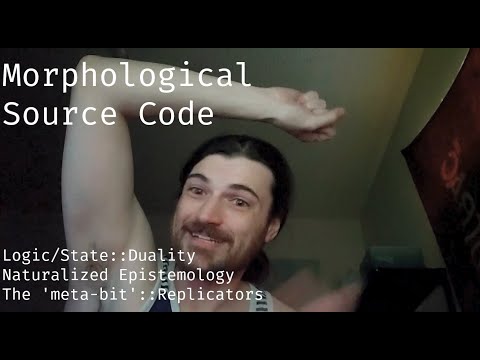
---
title: "Ontological Relativity & AI Singularity: Convening Epistemic Dualities and Morphological Source Code"
url: "https://www.youtube.com/watch?v=ecQevCn-fcI"
description: |
We need to talk more about the singularitie(s). The greats of the 20th century appear to have melted their darling wings on the sun of the pre-y2k information-age. I don't understand why the great philosophy of the past 50 years hasn't been about the digital/analogue singularity its the most important thing I can think of other than the intrinsically human singularities like time and cognition. I posit that we could have got started with the machine learning revolution 50 years ago and that we have more or less had the tools this whole time. It's not truly an engineering (consumer product/chipset), its an ontology problem - the truly dualistic data structure can reverse its own logic and give the chip blue prints straight to the fab, cutting out a few steps.

#Quine, #MorphologicalSourceCode, #Cognosis, #LLM, #Epistemology, #Philosophy, #ComputerScience, #Phenomenology, #FunctionalProgramming, #OpenAI, #Anthropic, #Strawberry, #Q*, #QStar, #Pathfinding, #Entropy, #QuantumInfoDynamics, #MetaProgramming, #MetaLanguage, #Singularity, #Ontology, #MachineLearningRevolution, #Cognition, #neuroscience, #ai, #ml, #machinelearning, #transformers, #replicatiors, #quine, #quines

0:33 wave/particle duality
3:00 free energy principle
5:00 observer observing a free energy differential field equation
6:23 P=NP reiteration, 'a field' of information
7:20 Observation collapsing the wave function of the global wave function
9:20 Cognition and extensive quantum entanglement
10:10 The 'bit' of (analogue) information
10:45 Jung and the collective unconscious
11:56 Plato and 'the cave wall' prerequisite of so-called language
12:29 Artificial truths, meta languages
12:47 <explains the arm singularity metaphor>
13:33 State/Logic duality
15:49 (double)Ontological Relativity
16:12 Blackbox Ontological Relativity
16:30 & The cognitive singularity
18:35 "Path Integral" (I'm sorry Dr. F, I will change this nomenclature)
18:58 ..is a singularity
19:16 Jungian binary?
19:45 Crystals??
20:30 Translation using meta language heuristics
21:10 'Object oriented' "Lo! It rabbiteth!"
22:28 "Path integral" -> "Quine/ModifiedQuine/Replicator"
23:10 Replicator is the 'meta-bit'
23:39 (irritating noise, sorry)
24:22 Agentic/Linguistic relativity
25:15 Double relativity ---- The agentic milieu is relative (intensive in thermodynamic char, despite burning heat to exist)?
26:00 Reiterate double relativity ----- 'Computational frame', 't=0 abstraction (implying a differential causal entanglement medium/milieu)'
28:20 Naturalized Epistemology
29:10 After much ado: "Morphological Source Code"
29:40 Informational 'meta-bit' reiteration (replicator)
30:21 Signal Processing compare and contrast
31:08 Continuous Variable Decomposition (Fourier Transform)
32:00 Reiterate what "Path integration [Quine/ModQuine/Replicator - versus Von Neumann-Turing conventional computational causal program planning (the 'morphological' aspect)]" is
32:24 Reversibility/self-reference singularity (meta CICD, 'crystal' [directed acyclic graph] structure)
33:00 'Work' & thermodynamics of information, language, or state/logic dualities
34:15 Morphology of the informatics singularity: "Path integration"
35:15 Functional programming meta paradigm of state/logic duality - modeled as a differential equation or evolutionary system
36:45 The phenomenology of double relativity observer(less) singularities
38:25 Harmonic time-abstracted / differential equations (signal processing analogy in reverse) '
38:55 replicators and cognitive systems speculative architecture
40:28 Quine/Replicator architecture
41:22 Replicatory holography
42:11 Possible causal 'triparte' - the code we had (git), the code we have(runtime), and the code we want (conclusion of and then reinstating of)
42:40 Replicator speculative thermodynamics of dynamical situations
44:00 reiterate/state quasi hypothesis about 'intensive' character of the computational moment abstracted as a differential equation
45:30 'live' programming example - I promise I'm a better coder when the camera isn't on
---
title: "Morphological Source Code & Quineic Statistical Dynamics Yoneda-Lemma/Matrix-Mechanics Arity-fulcrum"
url: "https://www.youtube.com/watch?v=I-DIj-G9pEQ"
description: |
Logical arity is seemingly the fulcrum of multiscale epistemological so-called emergence, broadly, 'information'. This would imply that Category & Morphism are fundemental, while Set is emergent. Heisenberg, Dirac, and Yoneda give us the formalism for such an ontology.
0:00 start
26:00 finMSC/QSD adopts a relational, morphism-first epistemology:
- Observables precede states
- Transitions precede sets
- Meaning is derived, not assumed
This orientation is inspired by:
- Heisenberg’s matrix mechanics (observables as transitions)
- Dirac’s representation-independent formalism
- Category-theoretic morphism primacy
- Practical constraints of computation, thermodynamics, and observability, chiefly staked-out for subsequent exploration:
- Mach & Noether (Einstein, Euler, etc.)
What follows is a conceptual RFC explaining why MSC/QSD is structured the way it is.
Heisenberg’s original insight (1925):
“One ought to concentrate one’s attention on things which are grossly connected with what one can observe.
The things one can observe, being each related to two states, are expressed naturally as a matrix-array of numbers.
One should consider the whole set of numbers, together.”
Things one can observe are relations between states, not isolated values.
Observable = ⟨m|X|n⟩ (transition amplitude)
An observable is not a number; it is a relation between two states.
X = { x_mn | for all m, n }
The observable is the matrix: the totality of possible transitions considered together.
By diagonalizing a given observable matrix, we obtain:
X |n⟩ = λₙ |n⟩
The eigenvectors define states relative to that observable.
States are not primitive entities; they are derived as stable patterns under measurement.
The set { |n⟩ } is not foundational in itself.
It is an operational equivalence class induced by a measurement context.
Operational corollary (Heisenberg–Dirac):
Sets are not epistemologically primitive.
Operationally meaningful sets are derived from observables (transitions).
This is not a claim about mathematical foundations; it is a claim about how structure becomes observable.
| Set Theory (ZFC) | Matrix Mechanics | MSC/QSD |
|---|---|---|
| Start with ∅ | Start with observables | Start with morphisms |
| Elements first | Relations first | Morphisms first |
| Static | Dynamic | Morphogenetic |
| Sets primitive | States contextual | Sets emergent |
Heisenberg (Matrix Mechanics):
- Observables = matrices
- States = vectors
- Evolution = matrix multiplication
Schrödinger (Wave Mechanics):
- States = ψ(x,t)
- Observables = operators
- Evolution = differential equations
They are mathematically equivalent, but Dirac’s bra–ket notation makes explicit that:
Matrix mechanics is representation-independent,
while wave mechanics is representation-dependent.
This distinction motivates the computational analogy below.
Mandarin Chinese offers a rare empirical instance of a naturally evolved morphological source code. Its logographic system (refined over three millennia) encodes meaning not as atomic symbols, but as structured compositions of semantic and phonetic morphisms:
形旁 (semantic radical) + 声旁 (phonetic component) ⇒ emergent concept
This is not metaphor. It is engineered morphology: each character is a decomposable equation, readable by both humans and (potentially) machines. Consider 象 (xiàng, “elephant”):
- Semantic field: ⻖ (tusk/animal)
- Phonetic hint: 豕 (shǐ, “pig,” approximating ancient pronunciation)
- Emergent meaning: “elephant”
The system’s origin lies in experimental semiotics and their application-through hermenuetics: Shang dynasty scribes carved glyphs into bone, then read meaning in the interaction between fixed form (the glyph) and stochastic fracture (the fire’s crack). The scribe was not a creator, but a witness to morphological emergence; a role mirroring the MSC/QSD observer.
Critically, Western computing remains blind to this paradigm. Treating Hanzi as atomic tokens ignores their internal transition structure. Yet this very structure satisfies the RFC’s core tenets:
- Observables precede states: Meaning arises from the relation between 形 and 意, not from either in isolation.
- Transitions precede sets: Characters are not elements of a set; they are orbits under morphological transformation (e.g., adding 氵 to 工 yields 江, “river”).
- Meaning is derived: No dictionary lookup needed—just decompose, relate, infer.
Thus, Putonghua is not merely a language. It is a closed noetic system; a living MSC. Being a, previously, "hooked-on-phonics" (which, no-hate; it may be that 'phonics' is 'what it took' to bootstrap the digital age) linguistic ['Western'] novice, like myself, that is just-now learning the Chinese-Language, after a lifetime of basically-ignoring it, it's-all a bit overwhelming and I apologize for any faux pas I may commit and will refrain from pointing and gawking (to-put it mildly; there are real problems associated with this thing I'm attempting to brush-off, right-now). Add-to it the fact that my cognitive horizons are expanding-at the same time as my vocabulary and awareness of Chinese, as-well as my unorthodox style (and project, tbh), can come-off as overly-excited and, regrettably-even, Orientalist. The one-defense that I have is that it's not ONLY the Chinese-language, indeed all idea/pictographic, hybrid-phonetic, or other non-phonics-only language demonstrate that morphism-first epistemology is not only possible, but historically and culturally actualized, and should I have to go-down fighting with any of my rhetorical cognitive comrades then let it be Jung, specifically, the identity and historical-cultural moment that is the hill I will die-on (and NOT Shopenhauer; allowing-for the reader to read between the lines, rather than stating it outright). The goal of this project is not co-invention, or piracy but recognition-of, and further-study and engineering-to; digitize Hanzi not as text, but as executable morphology.
Analogy (epistemic, not ontological):
Matrix mechanics : wave mechanics
::
MSC/QSD           : set-theoretic computation
In MSC/QSD, the primitive observable is a binary transition:
Morphism = bw₁ ⊕ bw₂
You do not observe a ByteWord in isolation; you observe how it transforms relative to another.
T_ij = bw_i ⊕ bw_j
This table plays the same epistemic role as Heisenberg’s observable matrix: the totality of possible transitions considered together.
Define an equivalence relation:
bw ~ bw' iff their XOR-transition profiles are identical
The resulting equivalence classes (orbits under XOR action) are derived states.
Definition (NULL): NULL is a ByteWord with no morphic effect under XOR, used to delimit observationally distinct equivalence classes.
A set is a finite sequence of ByteWords partitioned by NULL, where elements within a partition belong to the same transition-equivalence class.
Sets are NULL-delimited collections of morphically equivalent transitions.
MSC/QSD corollary:
Sets are not operationally primitive.
Sets are derived from morphisms and their stabilization.
# A ByteWord in isolation has no observational content
bw = ByteWord(0x93)

# Observation requires relation
bw1 = ByteWord(0x93)
bw2 = ByteWord(0xAC)

transition = bw1.xor(bw2)  # 0x3F

# Observable element:
# ⟨bw2|XOR|bw1⟩ = 0x3F
The set {bw1, bw2} is derived from the observable transition, not assumed beforehand.
This framework enforces a dyadic mode of cognition:
- No isolated facts
- No isolated meanings
- Always relation, contrast, transition
Conscious ↔ Unconscious
Ego ↔ Shadow
Persona ↔ Anima
This is not metaphorical ornamentation; it reflects the structural necessity of relational observability.
Traditional computing:
Data (sets) → Functions → Computation
MSC/QSD:
Morphisms → Transitions → Sets
Not:
- “What is the value?”
- “What does this mean?”
But:
- “How does this transform?”
- “What stabilizes under repetition?”
Meaning is not assumed; it emerges via morphological dynamics.
Mathematical:
XOR : ℤ₂⁸ × ℤ₂⁸ → ℤ₂⁸
Physical: Measurement requires a reference state. All observables are differences:
ΔE = E_final − E_initial
Morphological: A morphism always relates a source-role to a target-role.
Even the identity morphism:
X → X
requires a distinction between source and target roles, even when they coincide extensionally.
Process arity:
(state_before) → (state_after, transition_record)
Observational arity:
Measurement = before / after → difference
Matrix arity:
M_ij = ⟨i|op|j⟩
In MSC/QSD, these arities coincide operationally, indicating a shared underlying structure.
You cannot observe structure without relation. You cannot derive meaning without transition. You cannot have sets without morphisms.
Therefore; you cannot have cognition; morphological-extremes (values, as-in [[Extreme Value Theorem]]), without topology and motility.
NOUMENAL (inaccessible)
         |
  ==================== ← Undecidable boundary (halting problem)
         |
    NP-complete         ← Maupertuis domain: δS = 0 (global optimization)
   (breeding bubble)        • Quine speciation
         |                  • Fitness landscape traversal
         |                  • Holonomy search (non-Markovian)
  ==================== ← P/NP boundary (gauge transformation surface)
         |
   P-time interior       ← Barandes domain: d² = 0 (local stability)
(phenomenal lightcone)      • Quine replication (Markovian)
         |                  • Verification (holonomy closure)
         |                  • Observable physics
         |
      δS = 0 (Maupertuis)   ← Variational principle (global)
      d² = 0 (Barandes)     ← Differential stability (local)
┌─────────────────────────────────────┐
│ MORPHOLOGICAL SOURCE CODE (Python) │
│ - Defines the rules │
│ - Human-readable │
│ - The "law"; arbitrary/interpreted │
│ - The propagator/generator U(x,y) │
│ - "Macroscopic" │
└─────────────────────────────────────┘
│
for example: ▼ JIT compilation
┌─────────────────────────────────────┐
│ QUINEIC STATISTICAL DYNAMICS (C99) │
│ - Executes the rules │
│ - Machine-speed │
│ - The "execution" │
│ - The dynamics ψ(t+1) = U ψ(t) │
│ - "Microscopic" │
└─────────────────────────────────────┘
│
"Quine": ▼ self-observation
┌─────────────────────────────────────┐
│ THE SAME CODE, STATE/LOGIC │
│ - Python reads its own C output │
│ - C runs the Python-defined rules │
│ - The system observes itself │
│ - "Emergent" and/or "Entangled" │
│ - "RetardedAnalyticalContinuation" |
└─────────────────────────────────────┘
(v0.x.x)Release repos:
© 2025-26 https://gitlab.com/morphological/source/code
© 2025-26 https://github.com/Morphological-Source-Code
Historical:
Caution: not-for use; for archival/pedagogical purposes (engineering material)
© 2024-26 Phovos https://github.com/Phovos/
© 2023-26 Moonlapsed https://github.com/MOONLAPSED/
(v1.x.x)Release repos:
Not guaranteed to be on this platform, specifically, certain contrivances ado with CICD/others will break backwards compatability. Plan accordingly, if you see a future using MSC&QSD (Release).

