
OmniBioAI is an AI-native computational biology platform that unifies bioinformatics workflows, scientific AI, biomedical knowledge, reproducible execution, and governed computational infrastructure.
It provides a common operating layer for moving from:
scientific question → data → workflow → computation → evidence → interpretation
across local workstations, HPC clusters, containerized infrastructure, and cloud execution environments.
Built for computational scientists, bioinformatics engineers, AI engineers, and research teams developing reproducible biomedical AI systems.
OmniBioAI Studio is the primary user-facing environment for accessing and operating the platform.
| Resource | Link |
|---|---|
| 🌐 Website | https://omnibioai.org |
| 🖥️ OmniBioAI Studio | https://github.com/OmniBioAI/omnibioai-studio |
| 📚 Documentation | https://github.com/OmniBioAI/omnibioai-docs |
| 📊 Platform Control Center | https://control.omnibioai.org |
| 🧬 Workflows | https://github.com/OmniBioAI/omnibioai-workflow-bundles |
| 📦 Containers | https://github.com/orgs/OmniBioAI/packages |
| 🎥 Tutorials | https://github.com/OmniBioAI/omnibioai-videos |
| Platform | Scale |
|---|---|
| Source repositories | 40+ |
| Codebase | 3.0 M+ |
| Automated tests | 65,000+ |
| Microservices / platform services | 28+ |
| Bioinformatics & AI/ML plugins | 250+ |
| Connetors/ Integrators | 200+ |
| Workflow bundles | 350+ |
| Execution / HPC / cloud tools | 3,000+ |
| Container artifacts | 1,500+ |
| PubMed corpus | 29M+ unique abstracts |
| Biomedical vector index | 45M+ vectors |
Public counts distinguish verified or usable platform resources from registry entries where appropriate.
Live architecture, service health, and platform metrics:
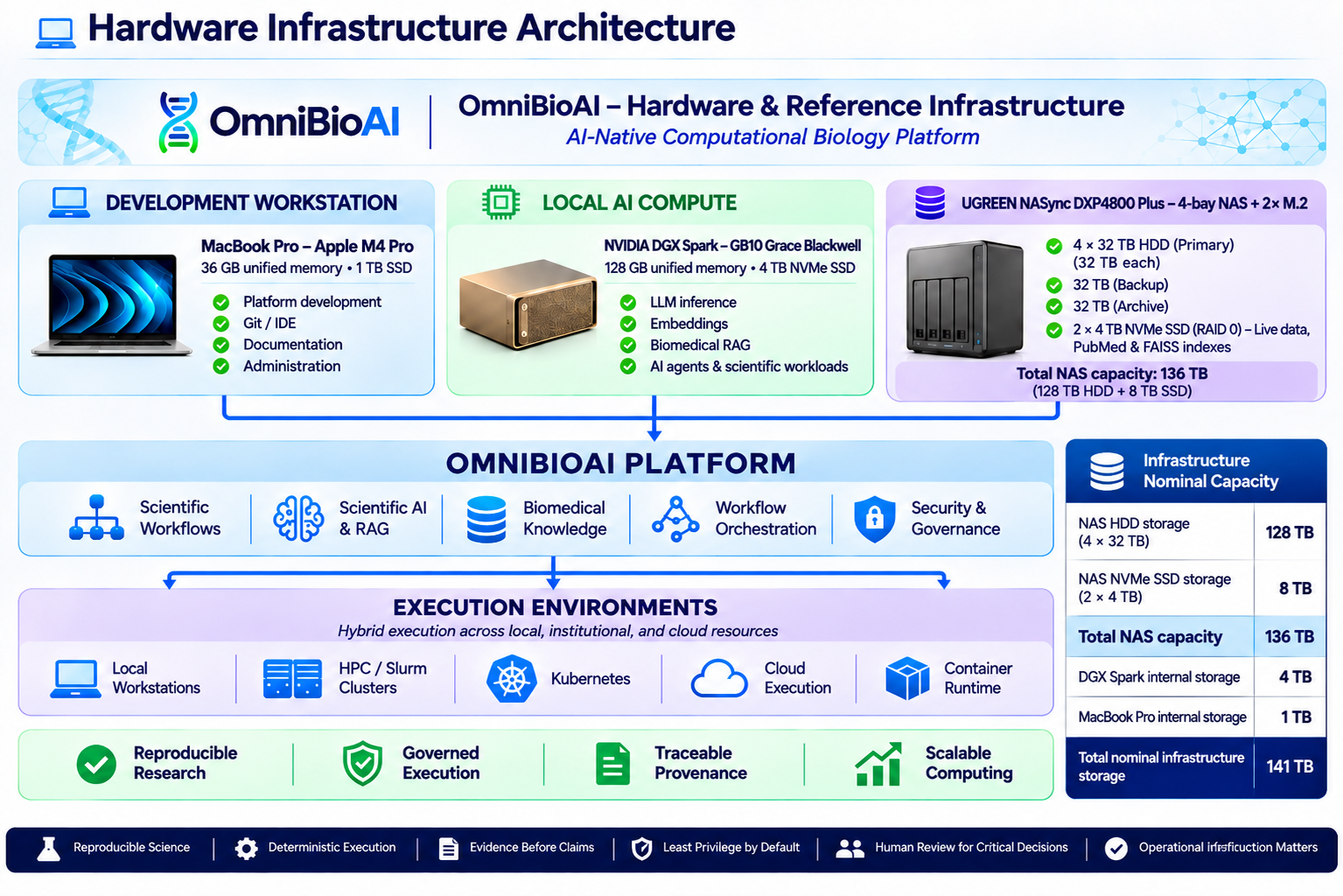
OmniBioAI is developed and operated on a dedicated, self-hosted computing environment combining local AI acceleration, centralized storage, and a developer workstation.
This infrastructure supports software engineering, scientific computing, local AI workloads, biomedical knowledge retrieval, model experimentation, and platform operations.
| Hardware | Configuration | Primary Responsibilities |
|---|---|---|
| NVIDIA DGX Spark | GB10 Grace Blackwell · 128 GB unified memory · 4 TB NVMe SSD | Local LLM inference, embeddings, biomedical RAG, latency-sensitive vector search, AI agents, and scientific AI workloads |
| MacBook Pro | Apple M4 Pro · 36 GB unified memory · 1 TB SSD | Platform development, Git, IDE, software engineering, documentation, administration, and remote infrastructure management |
UGREEN NASync DXP4800 Plus – 4-bay NAS + 2× M.2 NVMe
| Storage | Capacity | Designated Role |
|---|---|---|
| NVMe SSD pool (2 × 4 TB) | 8 TB | Reference genomes, PubMed corpus and vector indexes, sample datasets, container images, and models |
| HDD pool (2 × 32 TB) | 64 TB | Tenant-isolated user data and platform working data |
| Backup HDD (32 TB) | 32 TB | Nightly, encrypted, versioned backups of the NVMe and HDD pools |
| Archive HDD (32 TB) | 32 TB | Long-term archive and a second, independent versioned backup copy |
| Infrastructure | Nominal Capacity |
|---|---|
| NAS HDD storage (4 × 32 TB) | 128 TB |
| NAS NVMe SSD storage (2 × 4 TB) | 8 TB |
| Total NAS capacity | 136 TB |
| DGX Spark internal storage | 4 TB |
| MacBook Pro internal storage | 1 TB |
| Total nominal infrastructure storage | 141 TB |
The NAS separates storage responsibilities into distinct tiers:
- Performance tier: NVMe pool for reference genomes, the PubMed corpus, vector indexes, sample datasets, container images, and models. Latency-sensitive vector indexes are served from local NVMe on the compute node.
- Primary data tier: HDD pool for tenant-isolated user data and platform working data.
- Backup tier: dedicated 32 TB HDD with nightly, deduplicated, encrypted, versioned backups of both pools, verified by regular integrity checks and test restores.
- Archive tier: dedicated 32 TB HDD holding long-term archives and a second, independent versioned backup copy.
This design separates active computational workloads from tenant storage, backup operations, and archival data management.
Capacities are manufacturer-rated nominal capacities. Actual usable capacity depends on filesystem, RAID configuration, formatting, and storage allocation. The NVMe and HDD pools are striped for capacity and performance; data protection is provided by the separate backup and archive tiers. Backup and archive drives reside within the same NAS and should not be interpreted as independent off-site disaster recovery.
- Local AI computing: Hardware-accelerated inference, embeddings, retrieval, and scientific AI experimentation.
- Scientific data management: Centralized NAS infrastructure with NVMe-backed reference data and indexes, tenant-isolated data storage, dedicated backup, and long-term archival storage.
- Software engineering: Dedicated development and administration workstation.
- Reproducible execution: Support for containerized and workflow-driven computational environments.
- Hybrid computing: Integration with external HPC clusters and cloud infrastructure when additional resources are required.
This is the reference development infrastructure for OmniBioAI, not a mandatory hardware configuration. The platform is designed to support heterogeneous computing environments, including institutional HPC systems, cloud infrastructure, and local workstations.
OmniBioAI connects the major layers required for modern computational biology:
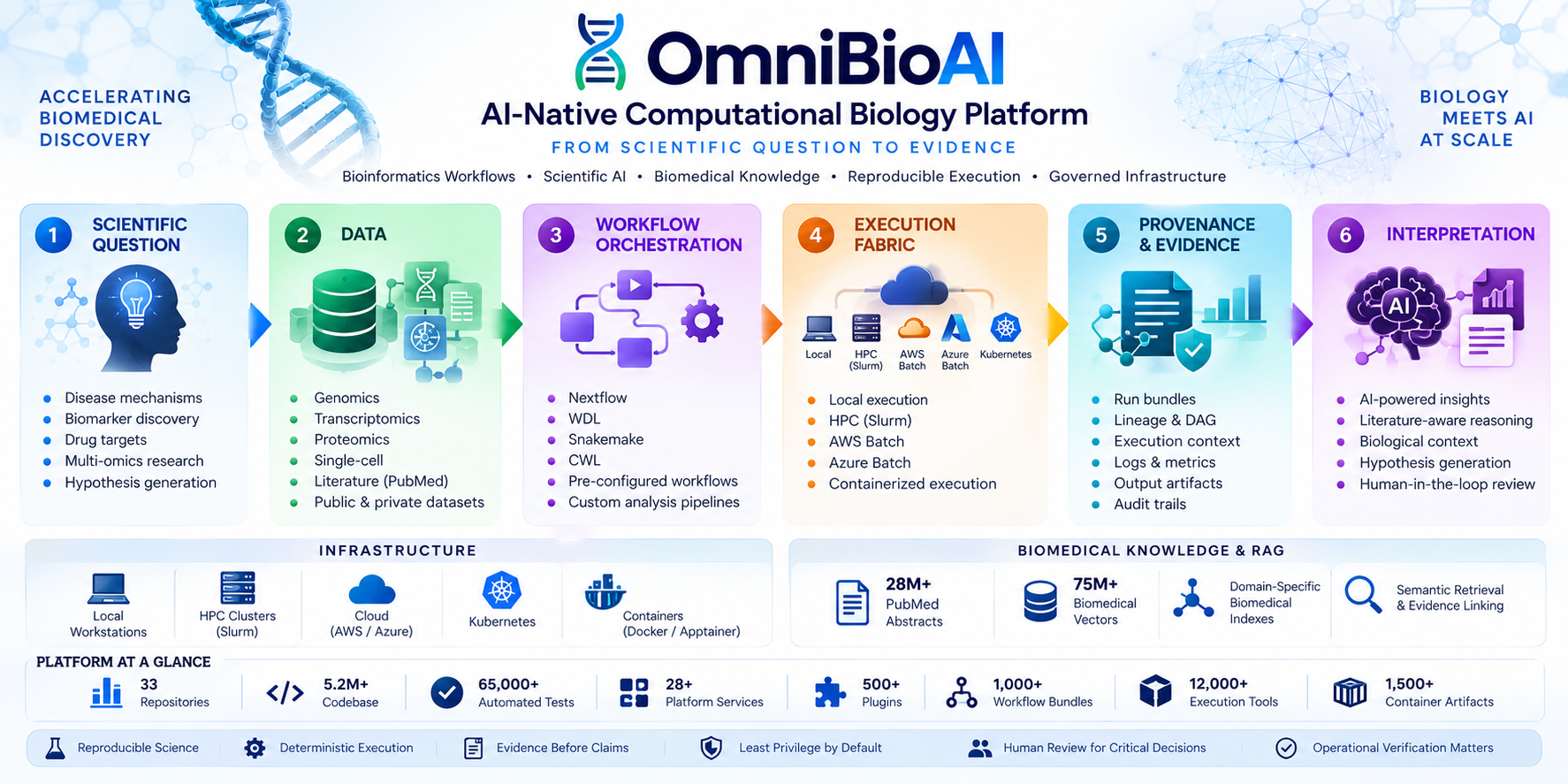
Integrated computational workflows for:
- Genomics
- Transcriptomics
- Single-cell analysis
- Variant analysis
- Proteomics
- Functional annotation
- Pathway analysis
- Comparative genomics
- Biomedical knowledge integration
AI operates alongside deterministic scientific workflows rather than replacing them.
Capabilities include:
- Scientific workflow planning
- Biomedical RAG
- Literature-aware reasoning
- Biological knowledge retrieval
- Scientific hypothesis generation
- AI-assisted interpretation
- Agent-driven tool execution
- Model lifecycle management
- Human-in-the-loop scientific review
OmniBioAI integrates biomedical literature and structured biological knowledge into a local retrieval and reasoning layer.
Current infrastructure includes:
- 28M+ unique PubMed abstracts
- 75M+ biomedical vectors
- Domain-oriented biomedical indexes
- Semantic retrieval
- Evidence-linked RAG
- Biological knowledge services
- Literature-aware scientific agents
External biological resources can be integrated through governed platform services and APIs.
A common workflow architecture supports:
Nextflow · WDL · Snakemake · CWL
Workflows can execute through a unified computational layer rather than being tied to a single infrastructure backend.
Scientific workloads can run across:
Local · Slurm/HPC · AWS Batch · Azure Batch · Kubernetes · Containers
The Tool Execution Service (TES) separates scientific workflow intent from the infrastructure on which computation executes.
OmniBioAI brings together scientific workflows, AI-assisted knowledge retrieval, and reproducible computational execution for biomedical research.
| Research Area | Example Applications |
|---|---|
| Cancer Research | Variant analysis, RNA-seq, pathway enrichment, molecular profiling, and literature intelligence |
| Single-Cell Biology | Cell annotation, differential expression, trajectory analysis, and cellular-state characterization |
| Multi-Omics Research | Cross-omics integration, functional interpretation, and biological pathway analysis |
| Biomedical AI | Evidence-linked literature retrieval, biological knowledge integration, and hypothesis generation |
| Translational Research | Reproducible analysis, evidence traceability, and computational result interpretation |
AI-assisted scientific interpretation is designed to complement validated analytical methods and expert review.
Reproducibility is a platform primitive rather than an afterthought.
OmniBioAI captures computational execution context including:
- Inputs and references
- Workflow definitions
- Tool and software versions
- Containers and environments
- Execution backend
- DAG and lineage
- Logs and metrics
- Output artifacts
Each execution can produce an auditable Run Bundle:
Run Bundle
├── Inputs
├── References
├── Workflow
├── Toolchain
├── Containers
├── Execution Backend
├── DAG / Lineage
├── Logs
├── Metrics
└── Outputs
This makes computational results easier to reproduce, inspect, trace, and audit.
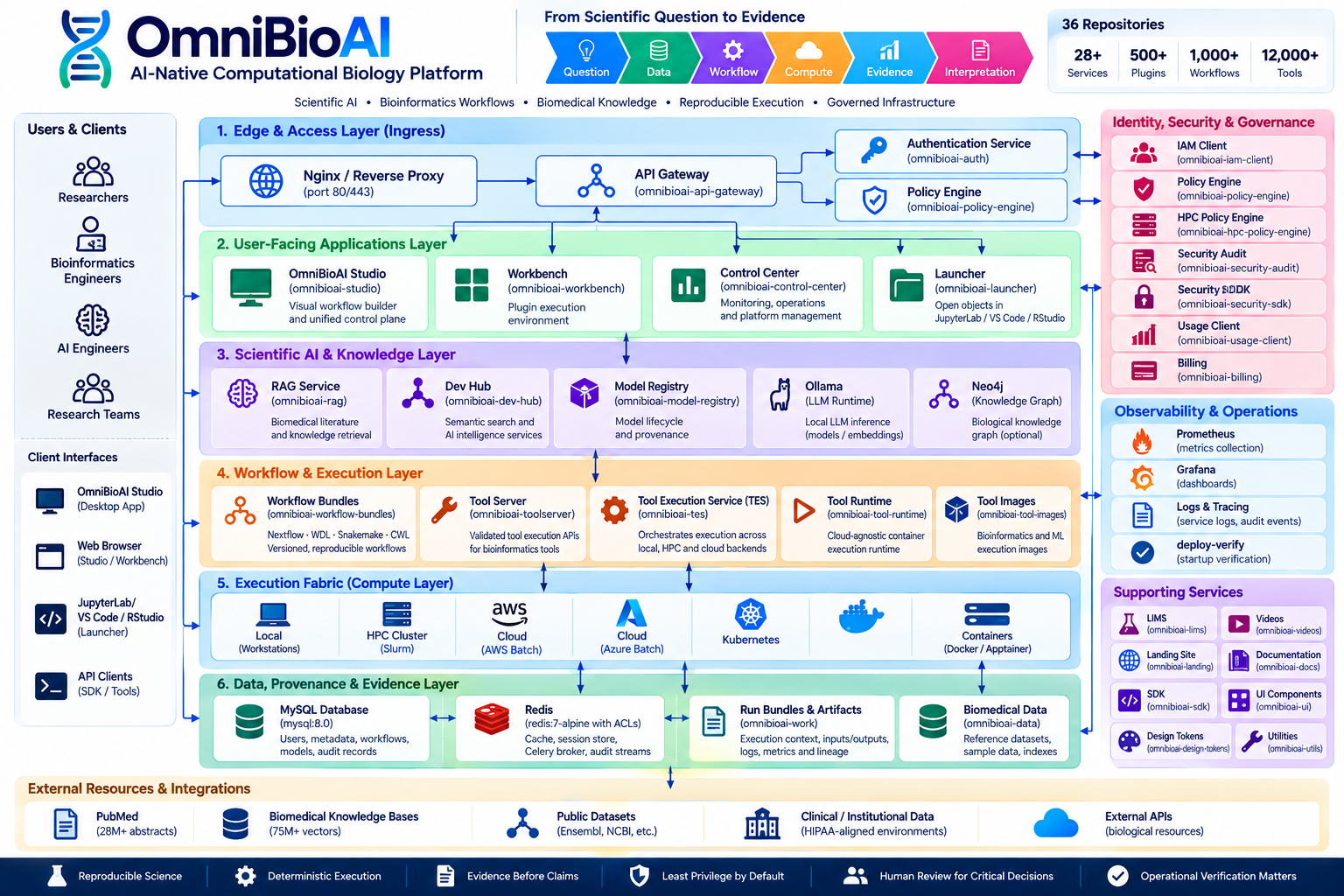
AI-native computational biology architecture spanning scientific AI, bioinformatics workflows, execution infrastructure, provenance, security, governance, and observability.
| Repository | Responsibility |
|---|---|
| omnibioai | Scientific platform and plugin ecosystem |
| omnibioai-studio | Primary user-facing environment and stack orchestration |
| omnibioai-control-center | Operations, security, readiness, and observability |
| omnibioai-workbench | Scientific plugin and analysis execution |
| omnibioai-launcher | Jupyter, VS Code, and RStudio integration |
| omnibioai-sdk | Python platform SDK |
| Repository | Responsibility |
|---|---|
| omnibioai-tes | Unified local/HPC/cloud Tool Execution Service |
| omnibioai-toolserver | Governed scientific tool API |
| omnibioai-tool-runtime | Container execution runtime |
| omnibioai-tool-images | Bioinformatics and AI/ML execution images |
| omnibioai-workflow-bundles | Versioned reproducible scientific workflows |
| Repository | Responsibility |
|---|---|
| omnibioai-rag | Biomedical retrieval-augmented generation |
| omnibioai-dev-hub | Semantic development and AI intelligence services |
| omnibioai-model-registry | Governed model lifecycle and provenance |
| Repository | Responsibility |
|---|---|
| omnibioai-auth | Authentication and identity |
| omnibioai-api-gateway | Zero-trust API gateway |
| omnibioai-policy-engine | RBAC/ABAC policy enforcement |
| omnibioai-hpc-policy-engine | Computational quota governance |
| omnibioai-security-audit | Durable security-event processing |
| omnibioai-security-sdk | Shared security primitives |
| omnibioai-iam-client | IAM client SDK |
| omnibioai-usage-client | Usage-event SDK |
| Repository | Responsibility |
|---|---|
| omnibioai-lims | Biological sample and metadata management |
| omnibioai-data | Reference and example datasets |
| omnibioai-docs | Technical documentation |
| omnibioai-videos | Tutorials and onboarding |
OmniBioAI is organized as a modular, multi-repository architecture in which platform capabilities are separated into independently developed components with defined responsibilities.
The ecosystem currently comprises 43 repositories spanning eight engineering domains.
| Architectural Domain | Core Components |
|---|---|
| AI & Agent Architecture | RAG, Model Registry, MCP, Skills, Workbench, Dev Hub |
| Distributed Execution | TES, ToolServer, Tool Runtime, Workflow Bundles, HPC Policy |
| Identity & Security | Authentication, API Gateway, IAM, Policy Engine, Security Audit |
| Platform Control Plane | Control Center, Ecosystem, Regression Framework, CLI |
| User Experience | Studio, Launcher, SDK, UI Components, Design System |
| Scientific Data | LIMS, Reference Data, Runtime Artifacts |
| Enterprise Services | Billing, Usage Metering, Database Initialization |
| Engineering & Delivery | Documentation, Owner Runbooks, Tutorials, Development Infrastructure |
The platform follows a separation-of-concerns approach:
- Experience Plane: User-facing applications and developer interfaces.
- AI & Intelligence Plane: Model integration, scientific reasoning, retrieval, agent orchestration, and knowledge services.
- Execution & Data Plane: Workflow execution, scientific tools, computational environments, and biological data services.
- Governance & Control Plane: Identity, policy enforcement, audit, observability, and platform operations.
This separation supports modular development, independently testable components, controlled integration, and heterogeneous deployment environments.
Repository boundaries represent engineering ownership and deployment boundaries where applicable; not every repository represents an independently deployed microservice.
OmniBioAI is designed as an extensible, AI-native computational biology platform. Its architecture separates scientific reasoning, AI orchestration, workflow execution, infrastructure management, and evidence generation into independently managed platform capabilities.
The architecture is guided by five principles:
- Model independence: AI workloads should not depend on a single LLM provider or inference runtime.
- Execution independence: Scientific workflows should operate across local, HPC, containerized, and cloud environments.
- Scientific determinism: AI reasoning assists analysis, while validated scientific tools remain responsible for deterministic computation.
- Evidence traceability: AI-generated interpretations and computational outputs should retain links to their underlying evidence.
- Governed extensibility: Plugins, services, agents, and integrations should operate through defined interfaces and authorization boundaries.
The AI layer supports a model-independent approach to scientific reasoning and tool execution.
Architectural capabilities include:
- Local and externally hosted LLM integration
- Model selection and task-oriented routing
- Agent orchestration and tool calling
- MCP-based integration capabilities
- Biomedical RAG and knowledge retrieval
- Model benchmarking and evaluation
- Human-in-the-loop scientific review
The knowledge layer connects biomedical literature, vector retrieval, structured biological knowledge, and scientific context.
Its architecture combines:
- PubMed literature ingestion
- PubMedBERT embeddings
- FAISS vector indexing
- Neo4j knowledge graph integration
- Semantic retrieval
- Evidence-aware retrieval and interpretation
The execution architecture separates workflow definitions from computational infrastructure.
Supported workflow technologies include Nextflow, WDL, Snakemake, and CWL.
Execution environments include local workstations, Slurm/HPC, container runtimes, Kubernetes, and cloud batch services.
Platform services are designed around centralized identity, authorization, policy enforcement, auditability, and operational visibility.
Architecture considerations include:
- Service identity and authorization
- Tenant-aware resource isolation
- Plugin lifecycle management
- Execution provenance
- Model and service observability
- Failure handling and recovery
- Operational readiness and verification
Important architecture decisions are documented to make the engineering rationale transparent, including model-serving strategies, vector-index design, plugin boundaries, workflow execution interfaces, and infrastructure deployment choices.
OmniBioAI is engineered around zero-trust and least-privilege principles for biomedical computational environments.
The security architecture includes:
- Identity and Access Management
- JWT-based authentication
- RBAC / ABAC authorization
- Organization and tenant isolation
- SAML-based enterprise SSO
- API gateway enforcement
- Service-to-service identities
- Scoped infrastructure identities
- Audit-event pipelines
- Policy enforcement
- Security posture monitoring
- Evidence-backed readiness tracking
Security controls are tracked through separate lifecycle states:
Implementation → Testing → Deployment → Operational Verification
This prevents source-code implementation or successful unit tests from being treated as equivalent to production verification.
OmniBioAI includes HIPAA-aligned technical safeguards and evidence tracking designed to support environments handling sensitive biomedical data.
These include:
least-privilege access · audit logging · retention controls · integrity verification · backup and recovery · security monitoring · evidence-backed control tracking
Verification status (November 2026): encrypted, versioned backups of both storage pools have been verified end-to-end, including a full read-back integrity check and test restores. Durable audit-event persistence is being operationally verified.
OmniBioAI does not describe these controls as HIPAA certification.
Operational and organizational compliance depends on the deployment environment, policies, procedures, agreements, and other applicable requirements.
| Layer | Technologies |
|---|---|
| Scientific Computing | Python · R · Bioinformatics · Multi-omics |
| AI | LLMs · RAG · Vector Search · Knowledge Graphs · Scientific Agents |
| Workflow | Nextflow · WDL · Snakemake · CWL |
| Backend | FastAPI · Django · MySQL · Redis · Redis Streams |
| Frontend | React · TypeScript · Vite |
| Infrastructure | Docker · Apptainer/SIF · Kubernetes · Slurm · AWS Batch · Azure Batch |
| Security | IAM · JWT · RBAC · ABAC · SAML · Service Identities · Audit · Policy Enforcement |
Scientific results should carry enough execution context to be reproduced and audited.
AI assists scientific workflows, while deterministic computational tools remain the execution authority.
Scientific interpretation should remain connected to evidence and provenance.
Users and services receive only the permissions and computational resources required for their responsibilities.
AI-generated scientific interpretations remain subject to human review.
A security or operational control is not considered operational simply because its source code exists or its unit tests pass.
| Resource | Link |
|---|---|
| 🌐 Website | https://omnibioai.org |
| 📊 Control Center | https://control.omnibioai.org |
| 🐙 GitHub | https://github.com/OmniBioAI |
| 📚 Documentation | https://github.com/OmniBioAI/omnibioai-docs |
| 🧬 Workflows | https://github.com/OmniBioAI/omnibioai-workflow-bundles |
| 📦 Container Registry | https://github.com/orgs/OmniBioAI/packages |
| 🤗 Hugging Face | https://huggingface.co/omnibioai |
| 🎥 Tutorials | https://github.com/OmniBioAI/omnibioai-videos |
| 💬 Discord | https://discord.gg/Hu6vgfAFn |
| 🐦 X / Twitter | https://twitter.com/OmniBioAI |
Senior Computational Scientist · AI-Native Bioinformatics Engineer
20 years of experience spanning bioinformatics, multi-omics, computational biology, HPC, cloud computing, software engineering, and scientific AI across the United States, Qatar, Malaysia, Saudi Arabia, and India.
Creator and lead engineer of OmniBioAI.
Building computational systems at the intersection of:
Biology × AI × Software Engineering × HPC × Reproducibility
Build the computational operating layer where biological data, scientific workflows, reproducible execution, and artificial intelligence converge to accelerate biomedical discovery.
⭐ Explore the platform, architecture, workflows, and open-source ecosystem at https://omnibioai.org