





Growth transformation leader turning fast, evidence-led judgment into measurable business improvement and stronger teams.
I draw on cross-functional experience to rapidly identify which change offers the greatest defensible business improvement relative to its cost, risk, and disruption. With existing owners, I pursue the least intervention necessary for that result, validate early signals against downstream quality, and turn useful learning into lightweight decision guidance. The objective is more capable teams and less overhead, not identical ways of working or a system that depends on me.
Across 15+ years, I've connected media investment, conversion, measurement, agencies, technology, and executive decisions in PE-backed, enterprise, and global environments. Performance marketing is the foundation; practical, collaborative growth transformation is the work.
My most recent enterprise work connected $15M+ in media across 180+ institutions with CRO, measurement architecture, agency governance, forecasting, internal capability building, and investment decisions. That work included a $500K cross-market reallocation, a separate nine-school Meta-versus-paid-search allocation test, agency RFP and partner-selection leadership, an in-house media capability built across three business units, and deeper platform-to-Salesforce signals used to optimize closer to applications and enrollments. Earlier work includes $100M+ global programs, 30+ person teams, an acquisition rebuild that drove ~500% growth in approved applications, and a measurement transformation that produced 86% YoY growth in web-qualified engagements while outperforming benchmarks by 3x.
Over the last year, that operating work has expanded further into AI systems: capability discovery, agent routing, structured context, bounded execution, receipts, client interoperability, self-maintaining workflows, and privacy-safe publication. I use software and AI as operating infrastructure for growth, not as a separate technical identity.
- The method: Compare possible interventions by expected value, confidence, cost and disruption; act on the highest-leverage defensible option with existing owners, and scale only what holds up.
- The people: Preserve useful practices and individual ownership; create concise decision guides that enable teams instead of making them dependent on a central expert.
- The scope: $15M+ recent media across 180+ institutions, $100M+ historical global programs, multidisciplinary teams, CRO, measurement and investment decisions.
- The results: A separate $500K reallocation, a nine-school allocation test, approximately 500% growth in WEX approved applications, and 86% YoY web-qualified engagement growth at Stand Together, with claim boundaries preserved.
- The tools: AI, analytics and operating architecture support better judgment, timely feedback and repeatable execution. They are not the goal.
The throughline: Simple method, demanding judgment. Find the highest-leverage change, prove its value, preserve what works, and leave others more capable of sustaining the improvement.
Choose the shortest useful path:
- How I work: The lightweight growth method
- 5 minutes: Executive Portfolio Index
- Evidence: Proof Ledger
- What the system can do: Capability Catalog
- See it reason: Try the System
- Architecture judgment: Decision Records
| Leadership question | Evidence | What it demonstrates |
|---|---|---|
| Can he run a complex growth system at enterprise scale? | Multi-Brand Education Growth System | $15M+ media scope, 180+ institutions, capital allocation, forecasting, partner selection, capability building, measurement, CRO, and executive cadence |
| Can he rebuild acquisition performance? | WEX App Growth Rebuild | ~500% growth in approved applications after a phased acquisition rebuild |
| Can he improve measurement and operating performance? | FFIA Measurement Model | 86% YoY growth in web-qualified engagements and 3x benchmark outperformance |
| Can he translate marketing performance into investment judgment? | Media Metrics to Financial Outcomes | CAC, LTV, payback, incrementality, capital allocation, and decision logic |
| Is the AI work architectural rather than experimental? | AI Operating System Reference | Capability discovery, bounded execution, receipts, interoperability, smoke tests, unit tests, security tests, and minimum necessary governance |
| Can he turn that architecture into usable operating systems? | Marketing Intelligence Agent + Marketing Ops Toolkit | Agent routing, source-aware synthesis, deterministic checks, platform workflows, and bounded mutation |
The portfolio is intentionally small. Each repository has a distinct role.
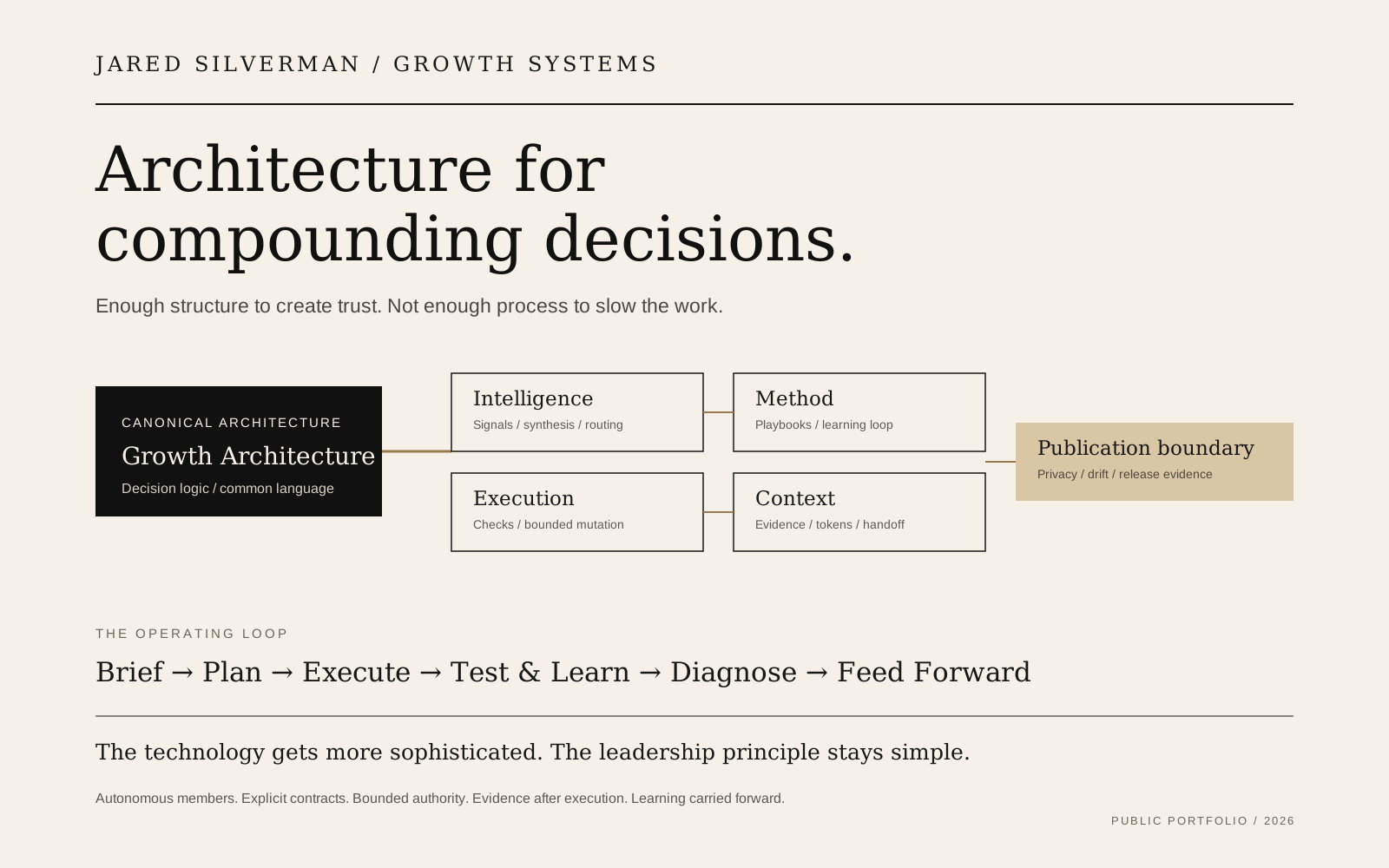
- Growth Architecture OS — the flagship. Growth leadership, capital allocation, operating models, case studies, playbooks, and the canonical AI operating-system reference.
- Marketing Intelligence Agent — the intelligence layer. Source-aware synthesis, explicit capabilities, agent routing, state-aware workflows, receipts, and client interoperability.
- Marketing Ops Toolkit — the execution layer. Deterministic checks, real marketing utilities, and five bounded mutation contracts.
- Private-to-Public Release Gate — the publication boundary. A Go implementation for privacy scanning, explicit export decisions, reviewed overlays, and Git-aware drift control.
- AI Context & Design System — the context-to-implementation layer. Structured brand and design context, extraction, tokens, CSS, component contracts, and validation.
- Marketing Ops Playbooks — the method layer. Reusable operating knowledge for taxonomy, data quality, funnel QA, performance diagnostics, and growth operations.
The older Brand Design System Starter remains public as a historical implementation reference but is no longer a primary portfolio entry point.
The AI Operating System Reference distills the architecture I use across larger private systems into a public-safe reference.
flowchart LR
    C[Trusted context] --> D[Capability discovery]
    D --> R[Routing]
    R --> A{Authority boundary}
    A --> O[Observe]
    A --> P[Propose]
    A --> M[Bounded mutation]
    O --> E[Receipt + evidence]
    P --> E
    M --> E
    E --> H[Human judgment / next action]
The operating principles are straightforward:
- simplify first;
- make the basic path work end to end;
- expose real capabilities rather than implied abilities;
- automate ordinary work without repeated permission loops;
- constrain mutation at the capability boundary;
- return evidence after execution;
- build health, cleanup, and maintenance into normal operation;
- add only the governance required to contain actual risk.
- Spend is capital allocation, not campaign management.
- Growth improves when investment, conversion, measurement, execution, and accountability operate as one system.
- Reporting should end in a decision, an owner, or a clearly named information gap.
- Governance should increase operating leverage, not add ceremony.
- Agencies should be managed against business outcomes, explicit standards, and clear decision rights.
- AI should compound judgment and repeatability, not create a second operating bureaucracy.
A résumé can summarize scope and outcomes. This portfolio shows the operating thinking behind them: how I diagnose, prioritize, allocate, govern, communicate, and build systems other people and AI agents can run.
The public repos intentionally expose reusable patterns rather than private systems, personal data, private integrations, or environment-specific infrastructure. Where private-derived work is published, the Private-to-Public Release Gate demonstrates the boundary discipline behind that process.
The underlying business claims are governed through the Growth Architecture OS claim system.
Usage and rights: this portfolio is public for professional review, not open-source reuse. See USAGE.md.