

Modern connection manager — SSH, RDP, VNC, SPICE, and more


Russian-localized fork of RustConn. Upstream changes are reviewed and merged manually. All workflows require a manual start; release builds create a draft, never a public release. See the update and release procedure.
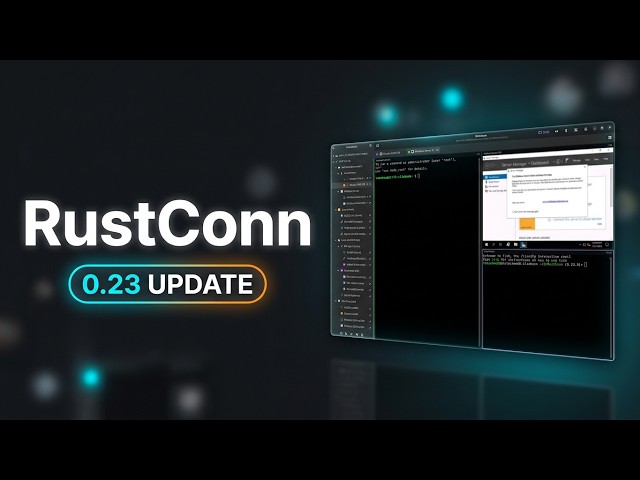
RustConn is a cross-platform connection orchestrator with a GTK4/libadwaita interface. It brings SSH, RDP, VNC, SPICE, MOSH, Telnet, Serial, Kubernetes, and Zero Trust connections under one roof — with embedded Rust clients where possible and seamless integration with external tools where needed. Runs on Linux (GTK4/libadwaita), macOS, FreeBSD, and Windows via WSLg.
 |
 |
 |
 |
 |
 |
 |
 |
More upstream screenshots are available on the original Flathub listing.
| Category | Details |
|---|---|
| File Transfer | SFTP file browser via system file manager (sftp:// URI, D-Bus portal) |
| Organization | Groups, tags, templates, custom icons (emoji/GTK), connection history & statistics |
| Monitoring | Remote host metrics bar (CPU, RAM, disk, network, load, system info) — agentless, per-connection toggle |
| Import | Asbru-CM, Remmina, SSH config, Ansible inventory, Royal TS, MobaXterm, SecureCRT, PuTTY/KiTTY (.reg), mRemoteNG (confCons.xml), Remote Desktop Manager, RDP files (.rdp), virt-viewer (.vv), libvirt (XML + daemon), CSV, native (.rcn) |
| Export | Asbru-CM, Remmina, SSH config, Ansible inventory, Royal TS, MobaXterm, SecureCRT, CSV, RDP files (.rdp), native (.rcn) — passwords are never exported |
| Security | KeePassXC (KDBX), libsecret, macOS Keychain, Bitwarden CLI, 1Password CLI, Passbolt CLI, Pass (passwordstore.org), script credentials; encrypted-file fallback with no keyring required (machine-bound or a portable file for use across machines); hardware-token SSH auth (FIDO2 security keys, PKCS#11 / YubiKey / smart cards); FIDO2 passkey redirection for RDP sessions |
| Terminal | Split terminals, command snippets, text highlighting rules, session recording, custom terminal themes, tab overview, tab pinning, OSC 133 shell integration (prompt navigation + failed-command marker) |
| Session Windows | Move any session (SSH, Telnet, Serial, Kubernetes, MOSH, Zero Trust, embedded RDP/VNC/Web) to its own window and back with Ctrl+Shift+M — per-monitor fullscreen, never reconnects |
| Automation | Expect rules, key sequences, pre/post-connect tasks, elevated credentials (sudo/su injection), output filters (ChromaTerm), cluster & ad-hoc broadcast, session reconnect, Wake-on-LAN |
| Networking | Jump hosts (bastions) picked per connection, per group, or as a global default — honoured by SSH, SFTP, RDP, VNC, and SPICE, with multi-hop chains and a per-connection Direct override; Open Browser via Tunnel — one right-click on an SSH host raises a SOCKS proxy and opens a browser (embedded or external Chromium) routed through it, to reach host-only web UIs; Multipath TCP for mobility & bandwidth aggregation (SSH/RDP/VNC), network-change auto-reconnect, port knocking, fwknop SPA; one-click QUIC (quicssh) ProxyCommand preset for SSH over QUIC (connection migration and UDP NAT traversal; quicssh installed separately) |
| Workflow | Smart folders, SSH port forwarding, visual SSH tunnel builder, workspace profiles (save/restore open sessions, including split layout and divider ratio), settings backup/restore, .rdp file association |
| Cloud Sync | Synchronize connections via shared cloud directory (Google Drive, Syncthing, Nextcloud, Dropbox); group sync with Master/Import access model; simple sync with UUID-based merge |
| CLI | rustconn-cli — headless management: list/add/update/delete connections, import/export, snippets, groups, templates, clusters, WoL, shell completions; optional secret and client-launch commands behind features |
| Languages | English, plus translations into Azerbaijani, Belarusian, Czech, Danish, German, Spanish, French, Italian, Georgian, Kazakh, Dutch, Polish, Portuguese, Russian, Slovak, Swedish, Ukrainian, Uzbek, Vietnamese and Simplified Chinese |
| Protocol | Client | Type |
|---|---|---|
| SSH | VTE terminal (port forwarding: -L/-R/-D) | Embedded |
| RDP | IronRDP / FreeRDP fallback (bundled in Flatpak) | Embedded + external |
| VNC | vnc-rs / vncviewer fallback | Embedded + external |
| SPICE | remote-viewer / virt-viewer | External |
| Telnet | VTE terminal | Embedded |
| Serial | picocom via VTE | External (bundled in Flatpak) |
| Kubernetes | kubectl exec via VTE | External |
| MOSH | mosh via VTE | External |
| Zero Trust | AWS SSM, GCP IAP, Azure Bastion, Azure SSH (AAD), OCI, Cloudflare, Teleport, Tailscale, Boundary, Hoop.dev | External |
| Web | Embedded WebKitGTK 6.0 browser (Linux) / System browser / Custom browser command | Embedded + external |
| Method | Command / Link |
|---|---|
| AppImage | Fork releases |
| Debian/Ubuntu (.deb) | Fork releases |
| Fedora (.rpm) | Fork releases |
| Flatpak file (.flatpak) | Fork releases |
| Arch Linux (AUR) | rustconn-ru is planned as a separately maintained package |
| From source | Rust 1.95+, GTK4 4.14+ (build guide); use this fork's source |
Use the installation commands included in the fork's release notes. The original
Flathub, Snap, OBS, Homebrew and rustconn AUR packages do not contain this fork's
Russian translation. Installed binary names and the application ID remain
unchanged; the fork is not intended for parallel installation alongside upstream.
Files attached to a GitHub release carry a signed build-provenance attestation —
verify a download with
gh attestation verify <file> --repo zbndev/RustConn-ru
(details).
Keyboard shortcuts are customizable in Settings → Keybindings; press Ctrl+?
in the app for the complete, always-current list.
| Document | Description |
|---|---|
| User Guide | Complete usage documentation |
| Installation | All installation methods and repository setup |
| Build Guide | Building from source, feature flags, per-distro prerequisites |
| macOS Build | Building and running on macOS, Homebrew, DMG packaging |
| Windows / WSL2 | Running RustConn on Windows via WSLg |
| CLI Reference | rustconn-cli commands and examples |
| Architecture | Crate structure and design decisions |
| CI & Build Flow | Manual upstream review, CI checks, four-format builds and draft releases |
| Zero Trust | Setup guides for each supported Zero Trust provider |
| Changelog | Release history and notable changes |
CONTRIBUTING.md covers development setup, the quality gate, and the conventions a pull request is checked against. Participation is under the Code of Conduct.
- Bugs and features — issue tracker; the forms ask for the version, install method, and desktop, which is usually what a diagnosis turns on.
- Questions — Discussions.
- Code — see the Build Guide and Architecture to get started.
- Translations — RustConn ships every catalogue listed in
po/LINGUAS; the.pofiles live inpo/. New languages and corrections are appreciated. - Vulnerabilities — privately, via Security Advisories rather than an issue (SECURITY.md).
GPL-3.0 — Made with ❤️